

Does an Emergency AC Repair Cost More Than Replacing a Failing Unit?

The Late-Night Cooling Crisis: When to Fix and When to Walk Away
Does an Emergency AC Repair Cost More Than Replacing a Failing Unit? When your air conditioning system suddenly stops blowing cold air in the middle of a sweltering July night, this question instantly becomes your top priority. A sudden cooling failure triggers immediate panic, especially when the indoor temperature starts climbing rapidly. You are suddenly faced with a high-stress decision: do you rush to find an immediate, after-hours fix just to get through the night, or do you take a step back and consider putting those premium emergency funds toward a permanent, reliable replacement?
Making a rational financial decision requires stepping back from the immediate heat and evaluating the long-term viability of your cooling equipment. Homeowners often feel pressured to authorize expensive, temporary band-aids simply to restore comfort quickly. However, without a clear understanding of your system's overall health, you might end up paying a massive premium for a repair that only lasts a few months. If you need immediate help evaluating your system, our comprehensive air conditioning services and emergency AC repair in Tacoma are designed to give you clear, honest answers. Expert technicians can help you weigh the true, long-term costs before you commit to a temporary patch on a dying machine.
What Qualifies as a True Cooling Emergency?
Not every air conditioning issue requires a midnight dispatch. Understanding the difference between a frustrating inconvenience and a genuine crisis helps you decide when to search for an ac emergency repair and when to simply schedule standard service during normal business hours. Assessing the situation calmly can save you from paying unnecessary after-hours premiums.
Here is a breakdown of what constitutes a genuine cooling emergency that requires an immediate response:
• Electrical burning smells: If you detect an acrid, burning plastic odor coming from your vents or the outdoor unit, this indicates a serious electrical failure. Shut the system off at the breaker immediately to prevent fire hazards.
• Complete system failure during extreme heat: When the system shuts down entirely during a severe heat wave and the indoor temperature reaches unsafe levels, a rapid response is necessary to protect the home and its occupants.
• Vulnerable individuals in the home: If your household includes infants, elderly family members, or individuals with medical conditions that make them sensitive to heat, a broken AC during a heat wave is an immediate health and safety priority.
• Leaking refrigerant or strange hissing noises: A hissing sound often points to a pressurized refrigerant leak. Because refrigerant is a chemical compound that requires specialized handling, this issue should be addressed promptly by a certified professional.
If your system is blowing slightly warm air but the house is still relatively comfortable, or if it is making a mild rattling noise that just started, you can typically safely turn the unit off and wait for a standard daytime appointment. Knowing these criteria ensures you only pay for emergency services when they are truly warranted.
The Hidden Math of After-Hours Compressor Failures
Emergency service naturally carries an after-hours premium, which heavily impacts the overall cost-effectiveness of a repair. When a major component fails late at night, the math changes significantly. The compressor is essentially the heart of your air conditioning system, responsible for pumping refrigerant through the lines. When it seizes or burns out, the labor and parts required to replace it are extensive, highly technical, and time-consuming.
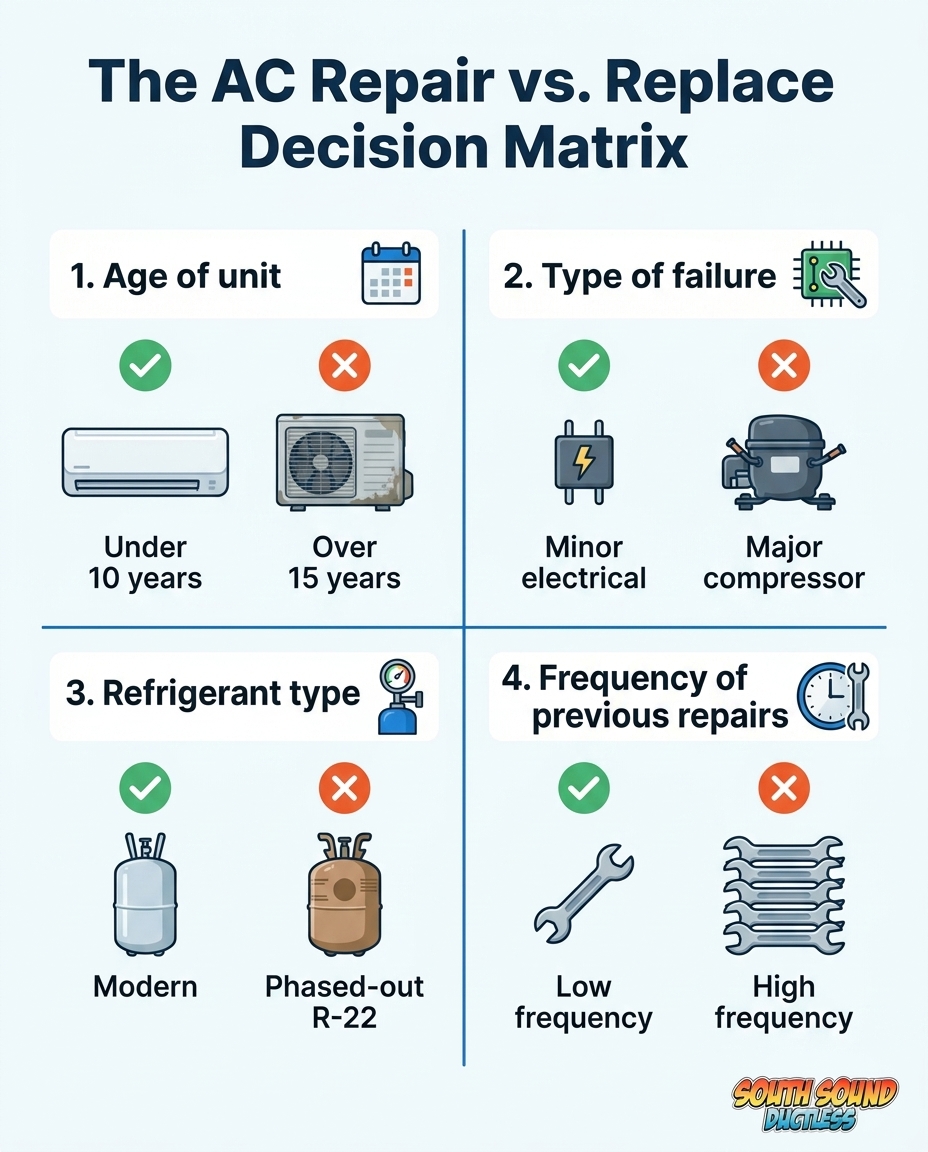
Applying the standard industry "age-times-cost" rule helps clarify the decision. The rule states that if the cost of the repair multiplied by the age of the unit exceeds the cost of a brand-new system, replacement is the far better financial choice. For example, pouring premium, after-hours emergency funds into a 15-year-old unit to replace a dead compressor is almost always a sunk cost. You are paying top tier rates to fix a single component inside a machine where every other part is also at the end of its functional lifespan.
Calculating the Sunk Cost Fallacy
The sunk cost fallacy occurs when a homeowner continues to pour money into a failing system simply because they have already spent money repairing it in the past. Previous repairs do not justify continuing to fund an obsolete machine. If you replaced the blower motor last summer and the condenser fan motor this spring, you might feel obligated to fix the compressor now to "protect" your previous investments. In reality, this pattern of frequent breakdowns is the clearest signal that the system has reached the end of the line. Redirecting those emergency repair funds into a high-efficiency upgrade stops the cycle of endless breakdowns and provides immediate, reliable comfort.
Why Patching an Aging System Delays the Inevitable
Keeping an obsolete system running is an uphill battle against degrading efficiency and discontinued technology. Older systems often rely on R-22 refrigerant, which has been phased out of production globally due to environmental regulations. Because new R-22 is no longer manufactured, any repair that requires recharging this specific refrigerant becomes highly resource-intensive, difficult to source, and exceptionally expensive.
Furthermore, a 15-year-old unit has already lost a significant portion of its original SEER (Seasonal Energy Efficiency Ratio) rating. Even if it was highly efficient the day it was installed, years of wear and tear, friction, and dirt accumulation mean it now costs substantially more to operate daily. Fixing one major component often puts additional strain on the remaining aging parts. When you install a brand-new, powerful compressor into an old system, the increased pressure can cause the older coils or aging blower motor to fail shortly after, leading to a cascading series of breakdowns.
• Efficiency — Repairing a 15-Year-Old Unit: Degraded SEER rating, high monthly energy bills. — Upgrading to a New System: Maximum modern efficiency, lower daily operating costs.
• Reliability — Repairing a 15-Year-Old Unit: High risk of cascading component failures. — Upgrading to a New System: Factory-fresh components designed to work together.
• Refrigerant — Repairing a 15-Year-Old Unit: Relies on phased-out, difficult-to-source R-22. — Upgrading to a New System: Uses modern, environmentally friendly refrigerants.
• Warranty — Repairing a 15-Year-Old Unit: Expired; all repair costs are out-of-pocket. — Upgrading to a New System: Comprehensive manufacturer warranty coverage.
Opting for a full AC replacement eliminates these compounding issues. Instead of waiting for the next part to fail, you restore reliable, efficient comfort to your home with a system backed by a comprehensive warranty.
The Impact of Sudden Heat Waves on Older Equipment
Contextualizing a sudden failure requires looking at the regional climate. Historically mild climates mean that many local homes have older cooling systems that were simply never designed for modern, extreme temperature spikes. When unexpected July heat waves hit Tacoma WA, these aging units are pushed far beyond their original design limits.
During these intense heat domes, a mild-climate system will run continuously without cycling off in a desperate attempt to reach the set temperature. This constant operation leads to rapid overheating, intense friction, and eventual compressor burnout. The system literally works itself to death because it lacks the cooling capacity to handle 95-degree-plus days.
The sudden spike in extreme heat also causes a simultaneous surge in demand for emergency services across the region. When hundreds of aging units fail on the same afternoon, parts availability becomes complicated, and wait times naturally increase. Upgrading to a modern, appropriately sized system ensures your home is fully prepared for the new reality of intense summer weather, providing peace of mind before the next heat wave strikes.
Alternative Cooling Solutions: Is It Time to Go Ductless?
When facing a major central AC failure, you have a unique opportunity to rethink your entire cooling strategy. You do not necessarily have to replace your old central system with an identical, traditional setup. Ductless mini-splits offer targeted, highly efficient cooling without the energy loss associated with aging, leaky ductwork.
For homes struggling with uneven cooling, hot upstairs bedrooms, or recent home additions, switching to a ductless setup can solve multiple comfort issues simultaneously. These systems use inverter-driven compressors that ramp up and down smoothly, providing precise temperature control rather than the harsh "on/off" blasting of older central units. Because they deliver conditioned air directly into the room, they bypass the energy waste of pushing air through dusty attic ducts.
If you decide that abandoning your failing central unit is the right move, professional ductless repair and installation teams can seamlessly transition your home to this modern, zoned technology, giving you customized comfort in every room.
Honest Diagnostics: Avoiding the Emergency Band-Aid Trap
In a moment of late-night panic, homeowners are incredibly vulnerable to quick fixes that do not serve their long-term financial interests. When the house is hot and the family is uncomfortable, the instinct is to authorize any repair that promises cold air. However, a reputable technician understands that taking an emergency dispatch fee just to apply a temporary band-aid to a dying machine is a disservice to the homeowner.
True professional service revolves around honest, transparent diagnostics. A qualified technician will evaluate the entire system's health, measuring refrigerant levels, testing electrical loads, and inspecting the condition of the coils, rather than just looking at the immediate broken part. If your 15-year-old unit has a burnt-out compressor, failing capacitors, and a leaking evaporator coil, a trustworthy technician will tell you that an after-hours fix is a waste of your money.
Our commitment to honest diagnostics means we refuse to blindly take an emergency dispatch fee without advising you if the unit is actually doomed. The goal is always to provide a clear, mathematical breakdown of the system's condition so you can make a confident, rational choice about your home's comfort investments.
Frequently Asked Questions About AC Repairs and Replacements
Is it worth repairing a 15 year old AC unit?
The short answer is usually no; repairing a 15-year-old AC unit is rarely a sound financial investment. At this age, the system has likely lost a significant amount of its original efficiency and relies on outdated technology or phased-out refrigerants. When a major component fails on a unit this old, the cost of the repair heavily outweighs the remaining value of the machine. Redirecting those funds into a modern, energy-efficient replacement provides better long-term reliability and lower monthly operating costs.
At what age should you replace an AC unit?
Most industry experts recommend planning for an AC replacement when the unit reaches 12 to 15 years of age. While some well-maintained systems can last up to 20 years, their efficiency drops drastically in the final years of operation. If your system is over a decade old and requires frequent repairs, or if your energy bills are steadily climbing, it is usually more cost-effective to replace it before it suffers a catastrophic failure during peak summer heat.
What is considered an AC emergency?
An AC emergency is any situation where a cooling failure poses a direct risk to your home's safety or your family's health. This includes electrical issues like burning smells, sparking, or continuously tripping breakers, which can indicate a fire hazard. Additionally, a complete system failure during extreme heat waves is considered an emergency if the home contains infants, elderly residents, or individuals with heat-sensitive medical conditions who cannot safely tolerate high indoor temperatures.
Should I fix my AC or buy a new one?
To decide whether to fix or replace your AC, apply the "age-times-cost" rule: multiply the age of the unit by the estimated cost of the repair. If that number exceeds the cost of a new system, replacement is the smarter choice. You should also factor in the frequency of recent breakdowns, the type of refrigerant the system uses, and whether your current energy bills are uncomfortably high. A professional diagnostic can provide the exact data needed to make this calculation.
How do sudden extreme summer temperatures affect older AC units?
Sudden extreme temperatures force older AC units to run continuously without their normal resting cycles, placing immense strain on aging motors and compressors. Systems designed for milder climates simply lack the capacity to cool a home during a 95-degree heat wave, causing them to overheat and eventually burn out. This continuous thermal load accelerates wear and tear, often turning minor underlying issues into catastrophic, system-ending failures overnight.
Make the Smart Choice for Your Home's Comfort
Answering the Big Question: Does an Emergency AC Repair Cost More Than Replacing a Failing Unit?
Deciding between a late-night repair and a full system replacement does not have to be a stressful guessing game. By taking a step back to look at the age of the unit, the severity of the mechanical failure, and the long-term efficiency losses, the right choice usually becomes mathematically clear. Pouring premium after-hours funds into a dying system in Tacoma WA is a sunk cost that only delays the inevitable. Instead, reach out for an honest, comprehensive evaluation to ensure your home stays comfortably cool without wasting your hard-earned money on doomed equipment. Does an emergency AC repair cost more than replacing a failing unit? When you factor in the repeated breakdowns, lost efficiency, and inevitable replacement costs, the answer is almost always yes.
"The DIY ductless installation was straightforward and saved us a lot of money! I highly recommend South Sound Ductless for their excellent support and quality products."


"Our new ductless system has transformed our home’s comfort level. The team at South Sound Ductless was professional and knowledgeable throughout the process!"
Get Your Comfort Today!
Contact us for expert HVAC solutions and consultations.
Stay Updated with Our Newsletter
Subscribe for expert HVAC tips, the latest updates, and exclusive promotions delivered right to your inbox.

FAQs
Here are some common questions about our HVAC services and ductless systems.
Ductless heating uses a system of indoor and outdoor units to provide efficient heating. These systems are ideal for homes without existing ductwork. They offer flexibility and can be controlled room by room.
Our DIY ductless program simplifies installation with pre-charged kits. You can easily mount the indoor unit, connect refrigerant lines, and set up the outdoor condenser. It's designed for quick and efficient setup.
Ductless systems provide energy efficiency, reducing utility bills while maintaining comfort. They improve indoor air quality and allow for customizable temperature control. Additionally, they take up less space than traditional systems.
Yes, we offer financing through Enhancify to make your HVAC investments more manageable. This allows you to enjoy comfort without the immediate financial burden. Explore our options to find a plan that suits you.
Regular maintenance is key to keeping your ductless system running efficiently. Schedule annual tune-ups and clean the filters regularly. This ensures optimal performance and prolongs the life of your system.
Still have questions?
We're here to help!