

How We Diagnose AC Units Freezing Up During July Heat Spikes
The Shock of a Frozen AC During Peak Summer Heat
You come home after a long shift during a sweltering afternoon, only to find the house is warm, the vents are barely blowing, and a puddle of water is forming under your indoor unit. At South Sound Ductless, our team knows this is an incredibly stressful scenario for local homeowners. Understanding exactly how we diagnose AC units freezing up during July heat spikes is critical when your system suddenly fails under pressure. It is incredibly frustrating to walk into a hot house, hear the air conditioner running constantly, and discover a solid block of ice forming on the evaporator coil inside your home.
This situation presents a strange paradox: how can an air conditioner turn into a block of ice when the temperature outside is soaring? The reality is that a frozen coil is a major symptom of a system that is struggling to breathe or process refrigerant correctly. When you reach out to our crew for professional air conditioning services, the immediate goal is to address this concrete problem safely. We have to make a crucial diagnostic decision: determining if the ice is caused by severe airflow restriction from a neglected filter, or if the system has suffered a deeper mechanical failure that requires extensive repair.
Before a South Sound Ductless technician even arrives, there are usually early warning signs that a freeze-up is imminent. If you know what to look for, you can often catch the issue before the coil becomes completely encased in solid ice.
• Weak airflow: The air coming from your supply registers feels incredibly weak, even when the fan is set to its highest speed.
• Warm air blowing: The system is running, but the air coming out of the vents feels lukewarm rather than crisp and cold.
• Unusual dripping: You notice water pooling around the indoor air handler or dripping from the ceiling if the unit is located in an attic.
• Strange noises: A whistling sound from the return vent or a struggling, humming noise from the blower motor often indicates restricted air.
The Physics Behind the Freeze: Airflow and Evaporator Coils
To understand why a system freezes, our technicians often explain the basic thermodynamics of how an air conditioner cools your home. Your AC does not actually create cold air; it removes heat from the indoor air. The indoor evaporator coil is filled with extremely cold liquid refrigerant. As warm air from your home is pulled across this cold coil, the refrigerant absorbs the heat and carries it outside. Under normal conditions, that constant flow of warm indoor air keeps the coil's temperature hovering just above the freezing point.
When something disrupts this delicate balance, the cooling process breaks down rapidly. The most common culprit we encounter is a dirty air filter, which acts like a wall, suffocating the system. If you are looking for reliable HVAC tips and troubleshooting, the first rule is always to check the filter. Without enough warm air passing over the coil, the refrigerant inside drops below 32 degrees Fahrenheit. The natural condensation that forms on the coil during the cooling process instantly turns to frost, and eventually, into a solid block of ice.
• Clean Filter (Normal) — Airflow Volume: High / Unrestricted — Coil Temperature: 38°F - 45°F — Condensation State: Liquid water (drains away) — Compressor Risk: Low (Normal operation)
• Slightly Dirty Filter — Airflow Volume: Moderate / Reduced — Coil Temperature: 32°F - 36°F — Condensation State: Heavy condensation / Sluggish — Compressor Risk: Moderate (Working harder)
• Clogged Filter (Restricted) — Airflow Volume: Severely Blocked — Coil Temperature: Below 32°F — Condensation State: Frost building on coils — Compressor Risk: High (Overheating risk)
• Frozen Solid — Airflow Volume: Zero Airflow — Coil Temperature: Well below freezing — Condensation State: Solid block of ice — Compressor Risk: Extreme (Failure imminent)
How Restricted Airflow Drops Coil Temperatures
The transition from a perfectly functioning air conditioner to a frozen block of ice can happen surprisingly fast during July heat spikes. As soon as the airflow is starved, the coil temperature plummets. The first layer of frost that forms on the aluminum fins actually acts as an insulator, preventing whatever little warm air is left from reaching the refrigerant. This creates a compounding effect. More frost builds up, further restricting the space for air to pass through, which drops the temperature even lower. Within a matter of hours, the entire A-coil or wall cassette can be completely encased in thick ice.
The Danger of Cranking the Thermostat
One mistake our South Sound Ductless team sees often is homeowners trying to force a struggling system to cool by drastically lowering the thermostat. If the house is 80 degrees and the AC isn't keeping up, dropping the thermostat to 65 degrees will not make the air coming out of the vents any colder. Air conditioners run at a single speed (unless you have a variable-capacity system). Lowering the thermostat simply tells the system to run continuously until it hits that target temperature.
When you force a system with a partially clogged filter to run 24/7, you multiply the restrictive effects. The continuous operation never gives the coil a chance to warm up and shed its condensation. Instead of cooling the house faster, cranking the thermostat is often the exact trigger that pushes a struggling, frost-covered coil into a completely frozen state.
Why Pacific Northwest Systems Are Highly Susceptible
Regional climate plays a massive role in how and why cooling systems fail. In our years serving Tacoma WA, we have noticed that our historically mild summers create a unique set of circumstances that make local systems highly susceptible to freezing over. Because the weather is often temperate throughout the spring and early summer, many homeowners simply do not run their air conditioners very often. The system sits idle, or is only used for brief periods on slightly warm afternoons.
This pattern of low usage often leads to skipped pre-season maintenance. Homeowners forget to change the air filter because the system hasn't been working hard enough to draw attention to itself. Dust, pet dander, and airborne particles slowly accumulate on the filter over months of inactivity or light use. The filter doesn't look terrible at a glance, so it gets ignored.
Then, the weather changes drastically. When those sudden 90-plus degree heatwaves hit the Pacific Northwest, systems go from running two hours a week to running around the clock. This sudden shift is a massive shock to a neglected unit. The partially clogged filter that was barely sufficient for a mild June afternoon completely suffocates the system under the heavy, continuous demand of a July heat spike. The overworked unit rapidly accelerates the freezing process, turning a simple forgotten maintenance task into a complete system shutdown.
Immediate Action: The First Steps to Take When Your AC Freezes
If you discover that your air conditioner or ductless unit is frozen solid, you must take immediate action to protect the equipment. A frozen system is not just an inconvenience; it is an active threat to the most expensive component in your HVAC system: the compressor. If the compressor continues to pump liquid refrigerant into a frozen coil, that liquid can flow backward into the compressor (a condition called "liquid slugging"), destroying the motor instantly. Here is exactly what our dispatch team recommends you do:
1. Turn the cooling off immediately: Go to your thermostat and switch the system mode from "COOL" to "OFF." This stops the outdoor compressor from running and halts the flow of cold refrigerant to the indoor coil. Do not wait for the house to cool down—turn it off right away.
2. Switch the fan setting to "ON": On your thermostat, change the fan setting from "AUTO" to "ON." This forces the indoor blower motor to circulate warm room air over the frozen coil, which dramatically accelerates the thawing process.
3. Check the air filter: While the system is thawing, locate your air filter and pull it out. If it is visibly caked with dust, dirt, or pet hair, throw it away. Do not put a dirty filter back into the system. If you do not have a replacement, leave it out temporarily while the system thaws.
4. Manage the melting water: As the thick block of ice melts, it will produce a significant amount of water. Check the drain pan under your indoor unit. You may need to lay down towels or use a wet/dry vacuum to prevent water damage to your floors or ceiling, as the volume of melting ice can easily overwhelm a standard condensate drain line.
5. Never attempt to chip the ice away: Do not use a knife, screwdriver, or any sharp object to break the ice off the coil. The aluminum fins and copper tubing are incredibly delicate. One slip can puncture a refrigerant line, turning a simple maintenance issue into a massive, expensive repair. Let the ice melt naturally.
Our Diagnostic Process: Ruling Out Deeper Cooling Issues
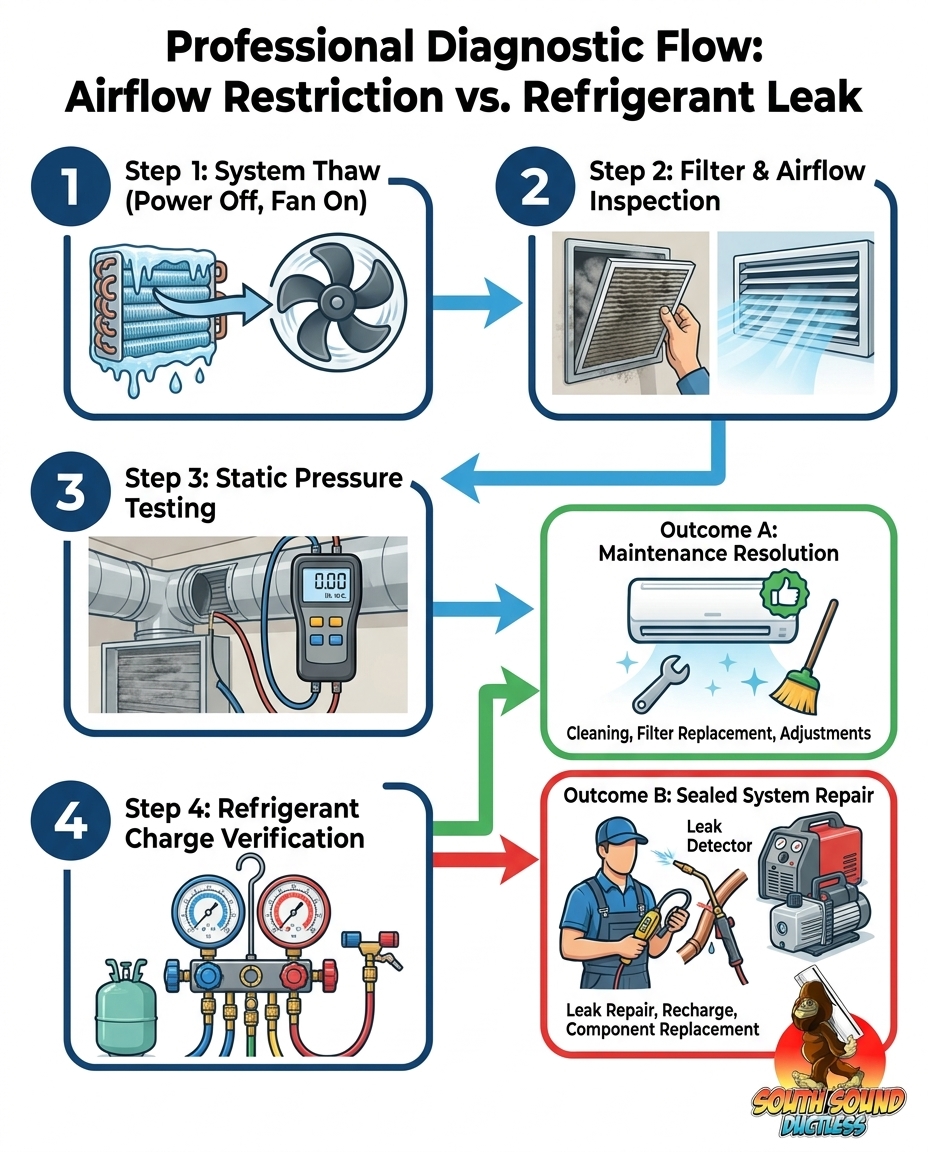
Once the system is completely thawed—which can take anywhere from 4 to 24 hours depending on the severity of the freeze—a professional can step in to find the root cause. It is physically impossible to accurately diagnose an air conditioner while it is encased in ice. The gauges will read incorrectly, the airflow cannot be measured, and the internal components are inaccessible. Patience during the thawing phase is mandatory.
When our South Sound Ductless technicians arrive, they bring rapid emergency diagnostics tailored to restore comfort quickly during unexpected regional heatwaves. The first step is verifying that the airflow dynamics have been restored. We check the blower motor to ensure it is pulling the correct amperage and spinning at the right speed. We also measure the static pressure within the ductwork. High static pressure tells us that the system is struggling to push or pull air, which confirms that a restrictive filter or blocked return vent was the primary culprit.
Routine AC maintenance is designed to catch these airflow restrictions early. However, if the filter was clean and the blower motor is operating perfectly, our diagnostic path shifts entirely. We then have to look at the sealed refrigeration system.
Assessing Airflow vs. Refrigerant Leaks
The critical diagnostic decision point is distinguishing between a simple maintenance failure and a sealed system breach. Low refrigerant levels cause the exact same freezing symptoms as a dirty filter. When a system is low on refrigerant due to a microscopic leak, the pressure inside the evaporator coil drops significantly. According to the laws of thermodynamics, a drop in pressure results in a drop in temperature. The coil gets too cold, and the condensation freezes.
To rule this out, our technicians use specialized digital gauges to measure the superheat and subcooling of the refrigerant lines. We also measure the temperature split—the difference between the air going into the return vent and the air coming out of the supply registers. If the airflow is perfect but the pressures are low, we know we are dealing with a leak. This requires specialized leak-detection equipment to find the breach, repair the copper line, and recharge the system to factory specifications.
Diagnosing Frozen Coils in Modern Mini-Splits
The diagnostic process takes on a different shape when dealing with modern, high-efficiency systems. As local specialists, we know a frozen ductless mini-split behaves differently than a traditional central air system. Instead of a large, hidden A-coil sitting in an attic or basement, the evaporator coil in a ductless system is located right inside the sleek wall cassette in your living room or bedroom. When these freeze, you will often see frost forming directly on the louvers, or experience water dripping directly down your interior walls as the ice melts.
Ductless systems are incredibly efficient, but they require specialized expertise to diagnose. Unlike central AC systems that use large, thick fiberglass filters, mini-splits rely on thin, washable mesh screens located at the top of the wall unit. These screens are excellent at catching dust and pet hair, but they clog much faster than traditional filters. If a homeowner neglects to wash these screens every few weeks, the delicate blower wheel (often called a squirrel cage) hidden behind the coil becomes impacted with dirt. This completely kills the airflow, causing the wall unit to freeze solid.
When providing ductless repair, our South Sound Ductless technicians don't just look at the indoor filters. We also have to inspect the outdoor compressor and the communication lines. Because mini-splits use inverter-driven compressors that constantly adjust their speed, a communication error between the indoor and outdoor unit can sometimes cause the system to pump refrigerant erratically, leading to a freeze. Diagnosing these advanced systems requires checking electrical signals and thermistors alongside traditional airflow and refrigerant checks.
Frequently Asked Questions About Frozen Air Conditioners
Why does a dirty filter cause my AC to freeze?
The short answer is that a dirty filter blocks the flow of warm indoor air from reaching the cold evaporator coil. Your air conditioner relies on that steady stream of warm air to absorb heat and keep the coil's temperature above the freezing point. When the filter is clogged, the coil is starved of heat, causing the internal refrigerant temperature to drop below 32 degrees. The natural condensation on the coil then turns to frost, eventually building into a solid block of ice.
What should I do if my AC coil is frozen?
The very first thing you must do is turn the thermostat's cooling mode to "OFF" to stop the compressor from running and prevent severe mechanical damage. Next, switch the fan setting to "ON" to continuously blow warm room air over the ice, which speeds up the thawing process. Check and replace your air filter if it is dirty, and prepare towels to catch the melting water. Never attempt to chip the ice away with a tool, as you can easily puncture the delicate refrigerant coils.
Why is my AC freezing up in the summer?
Most homeowners don't realize that high summer temperatures actually increase the likelihood of a freeze-up if the system is neglected. During a heatwave, your air conditioner runs continuously for hours at a time to keep up with the demand. If your air filter is even partially restricted, or if your system is slightly low on refrigerant, this continuous operation never gives the coil a chance to warm up and shed condensation. The heavy workload multiplies minor airflow issues into a major freezing event.
How long does it take for a frozen AC to thaw?
A frozen air conditioner typically takes anywhere from 4 to 24 hours to completely thaw, depending on the severity of the ice buildup and the temperature inside your home. Leaving the indoor fan running will significantly reduce this time by constantly moving warm air over the frozen components. A technician cannot accurately diagnose the root cause of the freeze—whether it's an airflow issue or a refrigerant leak—until all the ice has completely melted away.
Can a frozen AC fix itself if I just turn it off?
No, a frozen air conditioner will not fix itself permanently just by thawing out. While turning it off will melt the ice and temporarily restore airflow, the underlying problem that caused the freeze will still be there. If the cause was a severely clogged filter, replacing it might resolve the issue. However, if the freeze was caused by a failing blower motor, a blocked duct, or a refrigerant leak, the system will simply freeze solid again the next time you try to run it.
Is a frozen ductless mini-split diagnosed differently than central AC?
Yes, diagnosing a ductless system requires a slightly different approach because the components are engineered differently. Mini-splits use washable mesh filters and compact blower wheels that can become impacted with dust much faster than central systems, leading to rapid airflow restriction. Additionally, technicians must check the complex electronic communication signals between the indoor wall cassette and the outdoor inverter compressor, as a sensor failure can also cause a mini-split to freeze.
Restoring Your Comfort Safely and Quickly
A frozen cooling system is a serious symptom that always requires professional verification to ensure your equipment isn't suffering from a deeper mechanical failure. While a dirty filter is a common culprit, only a thorough diagnostic test can rule out a hidden refrigerant leak or a failing blower motor. Remember, the most important step you can take is leaving the system completely off until an expert can assess it.
Schedule your inspection for AC repair in Tacoma before the next wave of July heat spikes hits. By trusting South Sound Ductless to accurately diagnose AC units freezing up during July heat spikes, you ensure you get a clear explanation of the cause, immediate steps for safe operation, and the peace of mind that your system can handle the rest of the summer safely and efficiently.
"The DIY ductless installation was straightforward and saved us a lot of money! I highly recommend South Sound Ductless for their excellent support and quality products."


"Our new ductless system has transformed our home’s comfort level. The team at South Sound Ductless was professional and knowledgeable throughout the process!"
Get Your Comfort Today!
Contact us for expert HVAC solutions and consultations.
Stay Updated with Our Newsletter
Subscribe for expert HVAC tips, the latest updates, and exclusive promotions delivered right to your inbox.

FAQs
Here are some common questions about our HVAC services and ductless systems.
Ductless heating uses a system of indoor and outdoor units to provide efficient heating. These systems are ideal for homes without existing ductwork. They offer flexibility and can be controlled room by room.
Our DIY ductless program simplifies installation with pre-charged kits. You can easily mount the indoor unit, connect refrigerant lines, and set up the outdoor condenser. It's designed for quick and efficient setup.
Ductless systems provide energy efficiency, reducing utility bills while maintaining comfort. They improve indoor air quality and allow for customizable temperature control. Additionally, they take up less space than traditional systems.
Yes, we offer financing through Enhancify to make your HVAC investments more manageable. This allows you to enjoy comfort without the immediate financial burden. Explore our options to find a plan that suits you.
Regular maintenance is key to keeping your ductless system running efficiently. Schedule annual tune-ups and clean the filters regularly. This ensures optimal performance and prolongs the life of your system.
Still have questions?
We're here to help!