

Repairing a Refrigerant Leak vs. Upgrading to a New AC System

The Myth of the 'Routine' Refrigerant Top-Off
Adding refrigerant to your cooling system is not like putting gas in your car or topping off your windshield washer fluid, and it is certainly not a routine maintenance task. If you are weighing the decision between repairing a refrigerant leak vs. upgrading to a new AC system, the first step is understanding that a low refrigerant charge always indicates a physical breach in your equipment. When you are sweating through July peak heat and your vents are blowing warm air, our technicians frequently hear the same request: homeowners asking us to just add a little juice to get them through the season. However, in our experience, this common misconception leads many homeowners into a cycle of endless service calls and declining system performance.
For more details on how we evaluate and maintain home cooling, explore our comprehensive air conditioning services. The reality we share with every customer is that your air conditioner is a sealed, closed-loop machine. Under normal operating conditions, it should never consume, burn off, or use up its refrigerant supply. If the system is low, the chemical is escaping into the atmosphere. This means a quick recharge is only a temporary bandage. Eventually, that same chemical will leak out again, leaving you right back where you started. To make an informed choice about your home's comfort, you have to look beyond the immediate symptom and evaluate the long-term health of the entire cooling system.
Why Your AC Is Losing Refrigerant in the First Place
To understand why an ongoing leak is such a serious mechanical failure, it helps to know exactly how a closed-loop cooling system functions. Your air conditioner does not actually create cold air. Instead, it uses a specialized chemical—the refrigerant—to absorb heat from inside your home and release it outside. This chemical travels endlessly between the indoor evaporator coil and the outdoor condenser coil, changing from a liquid to a gas and back again. Because this loop is entirely sealed, the volume of refrigerant inside should remain exactly the same on day one as it does on year ten.
The causes of micro-leaks we typically see in the field:
• Formicary corrosion: Tiny pinhole leaks often develop on the indoor copper coils due to a chemical reaction between the copper and volatile organic compounds (VOCs) found in household cleaners, hairsprays, and building materials.
• Vibration and wear: The outdoor unit vibrates every time the compressor kicks on. Over thousands of cycles, this constant movement can wear down joints, weaken solder connections, and cause the copper lines to crack.
• Physical damage: Weed whackers, lawnmowers, falling branches, or even shifting soil can dent or puncture the delicate refrigerant lines running outside your home.
Because these leaks are often microscopic, locating them is never a DIY project. Finding a breach requires specialized training, electronic sniffer tools, ultraviolet dye injections, and high-pressure nitrogen tests. Handling the chemicals themselves also requires strict EPA certification. A quick ac fix is impossible if the underlying hole isn't located and permanently sealed. If you suspect a breach, professional AC repair is the only way to accurately diagnose the severity of the damage. Without sealing the leak, any new refrigerant added to the system will simply vent back into the atmosphere, forcing you to pay for the same a/c repair repeatedly.
The Hidden Risks of Patching Older R-410A Systems
At South Sound Ductless, we spend a lot of time educating homeowners on how the conversation around fixing refrigerant leaks has changed dramatically over the last few years due to shifting environmental regulations. If your home relies on equipment installed more than a few years ago, you are likely using a refrigerant known as R-410A. While this chemical was once the industry standard, it is now being actively phased out by the federal government under the American Innovation and Manufacturing (AIM) Act.
Understanding the AIM Act and R-410A:
• The environmental impact: R-410A belongs to a class of chemicals called hydrofluorocarbons (HFCs). While they do not deplete the ozone layer, they are potent greenhouse gases. Leaking these chemicals into the atmosphere carries a heavy environmental toll.
• The phasedown schedule: The EPA has mandated an 85% reduction in the production and consumption of HFCs by the year 2036. A massive step-down in production already took place in 2024, meaning far less R-410A is being manufactured today.
• The reality of supply and demand: As the supply of virgin R-410A shrinks, relying on an older system that constantly needs to be refilled becomes a volatile and unsustainable strategy.
For homeowners with older R-410A dependent AC systems, this phasedown changes the entire repair equation. You are no longer just fixing a piece of metal; you are tying your home's comfort to a chemical that is becoming obsolete. Sinking resources into a system that relies on a phased-out refrigerant is a significant risk. When a major component eventually fails, or the leak worsens, you may find that keeping the old system running is simply no longer viable. Framing your decision around technological obsolescence, rather than just the immediate inconvenience of a warm house, is the smartest way to approach a failing system.
How July Heat Spikes Expose Failing Compressors
Refrigerant does much more than just cool the air blowing through your vents; it also plays a critical role in cooling the air conditioner's compressor. The compressor is the heavy-duty engine of your outdoor unit, responsible for pumping the chemical through the lines. As the compressor works, its internal motor generates an enormous amount of heat. It relies on the cold, returning refrigerant vapor to wash over its motor windings and keep it from overheating.
With Tacoma's increasingly sharp summer heat spikes, our emergency dispatch board frequently lights up with compressor failures. A slow, unnoticeable leak that starts in the mild days of spring quickly transforms into a sudden cooling emergency when the weather turns hostile. During July peak heat, your air conditioner is forced to run for longer cycles to overcome the outdoor temperatures. If the system is operating with a low refrigerant charge, our technicians see two catastrophic things happen simultaneously.
First, the system loses its cooling capacity, meaning it runs continuously without ever reaching the temperature set on your thermostat. Second, because there is not enough cold vapor returning to the outdoor unit, the compressor begins to overheat. This thermal overload causes the internal oil to break down, increases wear on the mechanical parts, and eventually leads to burned-out motor windings. What could have been a manageable situation turns into a total system failure precisely when you need relief the most. Operating a compromised system during a heatwave doesn't just waste energy; it actively destroys the most vital component of your equipment.
Evaluating the Sunk Cost of Repeated A/C Repairs
When our team arrives at a home with a malfunctioning air conditioner, we often see homeowners falling victim to the sunk cost fallacy. This is the psychological trap of pouring more resources into a failing system simply because you have already invested time and effort into maintaining it. To help our customers avoid throwing good money after bad, we use a clear, objective framework to determine the break-even point between patching a leak and planning a full replacement.
1. Evaluate the age of the unit: Air conditioners are typically designed to last 10 to 15 years under ideal conditions. If your system is approaching or has exceeded this lifespan, the metal coils are likely degrading. Fixing one pinhole leak today often means waiting for the next thin spot in the copper to burst tomorrow.
2. Track the frequency of service calls: A healthy system never needs a refrigerant top-off. If you find yourself scheduling an ac fix every spring just to get the system cooling again, the unit is actively failing. Multiple top-offs over consecutive seasons are a glaring red flag that a permanent replacement is necessary.
3. Check your warranty status: Most manufacturers provide a 5-to-10-year warranty on major components like the compressor and coils. If your system is out of warranty, the homeowner carries 100% of the risk. Paying out of pocket to locate and braze a leak on an expired system is rarely a sound investment.
4. Assess your overall cooling performance: Even after a repair, older systems often struggle to dehumidify the air or maintain consistent temperatures across different rooms. If the system runs constantly but the house still feels sticky and warm, the equipment is no longer capable of meeting your needs.
If you are constantly nursing an aging unit through the summer, it is time to step back and look at the bigger picture. You can learn more about weighing these factors by reading our guide on the cost of emergency AC repairs versus replacing a failing unit. Breaking free from the sunk cost fallacy allows you to invest in reliable, long-term comfort rather than temporary bandages.
When to Choose an A/C Repair vs. When to Upgrade Your System
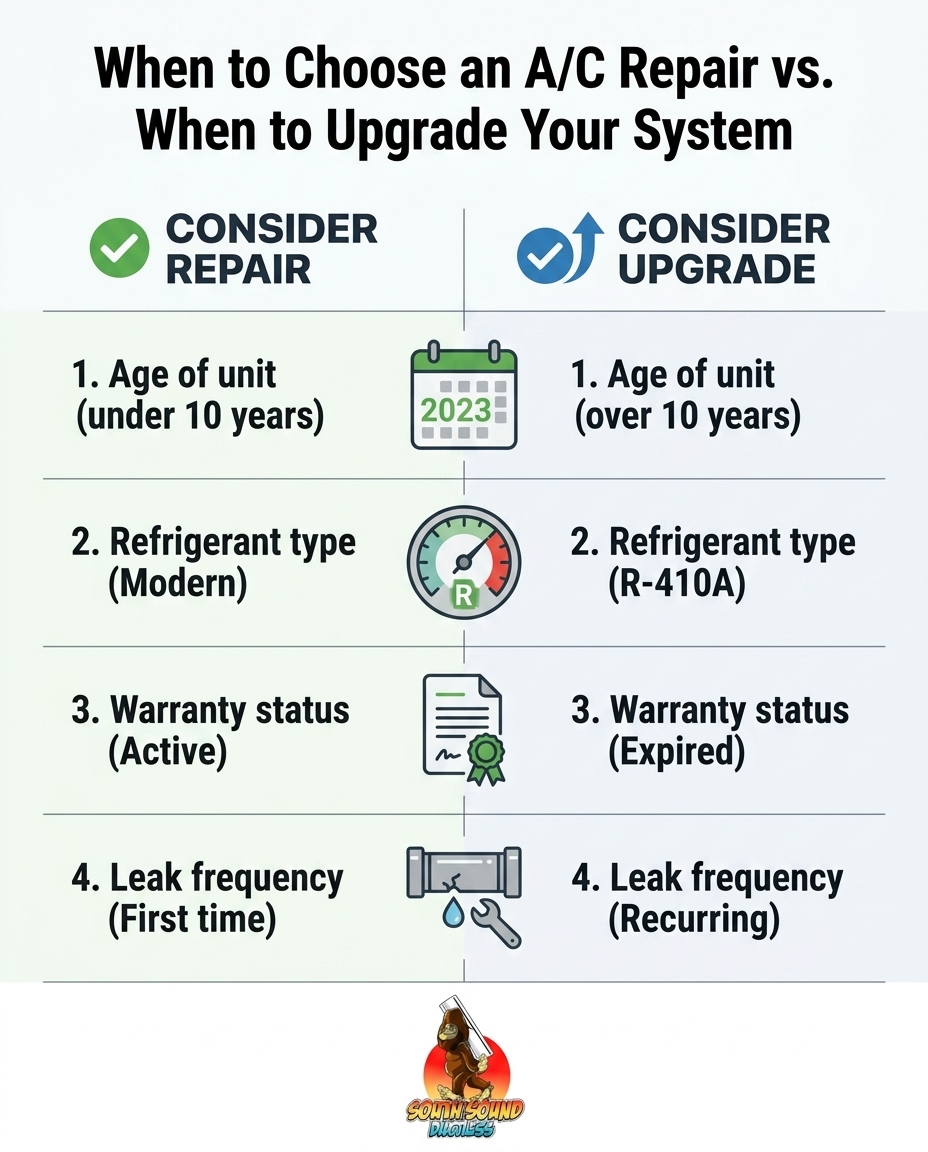
Making the final call requires looking at the facts side-by-side. While every home is unique, our team typically sees certain patterns clearly point toward one solution over the other. The table below outlines the scenarios where repairing makes sense versus when a full system upgrade is the smartest path forward.
• Unit Age — When to Repair the Leak: Under 10 years old — When to Upgrade the System: Over 10 to 15 years old
• Warranty Status — When to Repair the Leak: Active manufacturer warranty covers parts — When to Upgrade the System: Warranty has expired; homeowner bears all risk
• Refrigerant Type — When to Repair the Leak: Uses modern, widely available refrigerant — When to Upgrade the System: Older R-410A dependent AC systems
• Leak Frequency — When to Repair the Leak: First-time issue; single accessible leak — When to Upgrade the System: Multiple leaks; requires seasonal top-offs
• System Performance — When to Repair the Leak: Cools the home evenly and efficiently — When to Upgrade the System: Struggles to cool; runs constantly; high energy bills
Signs It's Time to Stop Patching
Even if your system is relatively young, certain physical symptoms indicate that the damage is too severe for a simple patch. If you notice any of the following signs, upgrading is likely your best option:
• Frequent icing on the evaporator coils: When refrigerant levels drop, the indoor coil absorbs too much heat too quickly, causing condensation to freeze solid. A block of ice on your indoor unit is a severe warning sign.
• Continuous running without reaching the set point: If your thermostat is set to 72 degrees but the house never gets below 78, the system has lost its cooling capacity and is wasting massive amounts of electricity.
• The system requires R-410A to operate: As discussed, tying your home's comfort to a phased-out chemical puts you at a severe disadvantage for future maintenance.
Upgrading to a new system provides a definitive solution to the ongoing anxiety of system reliability. Instead of wondering if your AC will survive the next heatwave, you gain the peace of knowing your home is protected by modern, highly efficient technology.
The Advantages of Moving Away from Centralized Systems
If you have decided that replacing your failing unit is the right move, you do not have to settle for another traditional, centralized air conditioner. Upgrading isn't just about swapping out a metal box outside your home; it is an opportunity to fundamentally improve your overall home comfort and energy efficiency. As a forward-thinking authority in home climate control, our team at South Sound Ductless advises against sinking resources into obsolete technology. Instead, we highly recommend evaluating high-efficiency heat pumps and ductless mini-splits as the ultimate modern upgrade.
Why we recommend ductless systems over aging central ACs:
• Elimination of ductwork losses: Traditional central systems lose a massive amount of cooling energy as air travels through leaky, uninsulated ductwork in hot attics or crawlspaces. Ductless systems deliver cooling directly to the living space, ensuring zero energy is wasted in transit.
• Inverter-driven compressors: Older ACs operate on a simple on/off cycle, blasting cold air until the thermostat clicks off, then waiting until the house gets warm again. Modern ductless systems use variable-speed inverter technology. They continuously adjust their output to match the exact cooling demand of the room, running quietly at lower speeds to maintain a perfectly even temperature.
• Customized zoning: Instead of relying on one central thermostat to dictate the temperature for the entire house, ductless units allow you to control individual zones. You can keep the living room cool during the day and focus the cooling on the bedrooms at night.
Because these systems are incredibly energy-efficient, they are heavily incentivized. Federal tax credits and local utility rebates may apply to qualifying high-efficiency heat pump installations, making the transition more accessible than ever. We always advise homeowners to consult a professional to see which generic incentive programs their specific household might qualify for. If you live in Tacoma WA, exploring the benefits of upgrading to a new ductless system is the smartest way to future-proof your home.
Frequently Asked Questions About Refrigerant Leaks and AC Replacement
Is it worth fixing a refrigerant leak in an AC?
The short answer is that it depends on the age of the unit and the type of refrigerant it uses. If your system is under ten years old, uses modern refrigerant, and has a single, easily accessible leak, an ac fix is usually worth the investment. However, as we often see in the field, if the unit is older, out of warranty, or relies on phased-out R-410A, repairing the leak is often a sunk cost. Repeatedly patching an old system rarely extends its life significantly.
Why does my AC keep losing refrigerant?
Air conditioners are closed-loop systems, meaning they should never lose refrigerant under normal conditions. If your system keeps losing its charge, it has a physical breach in the copper lines, the evaporator coil, or the condenser coil. These micro-leaks are typically caused by formicary corrosion, ongoing vibration, or physical damage to the outdoor lines. Until a licensed technician locates and brazes the hole, the system will continue to leak.
What is the R-410A phase-out?
The R-410A phase-out is a federal mandate under the EPA's AIM Act designed to reduce the use of hydrofluorocarbons (HFCs), which are potent greenhouse gases. The government is enforcing an 85% phasedown in the production and consumption of these chemicals by 2036. As a result, the supply of virgin R-410A is shrinking rapidly, making older systems that rely on this chemical increasingly difficult and risky to maintain.
How long will an AC last after a freon leak?
If our technicians successfully locate the exact source of the leak, repair the copper, and recharge the system, the AC can theoretically last for several more years. However, if the leak was caused by widespread corrosion across an aging indoor coil, a new leak will likely develop shortly after the first a/c repair. For older systems, a leak is usually a symptom of terminal wear and tear rather than an isolated incident.
Does a refrigerant leak mean I need a new AC?
A refrigerant leak does not automatically mean you need a completely new system, but it is a strong indicator that you should start planning for one. If the leak occurs in an aging system or requires replacing a major component like the evaporator coil, our team usually recommends upgrading the entire unit as the smarter long-term choice. Replacing the system eliminates the ongoing stress of breakdowns and protects you from the realities of chemical phase-outs.
Make the Right Call for Your Home's Comfort
After years of keeping Tacoma homes cool, we know that a reliable cooling system is essential for your peace of mind, especially when the summer weather turns sharply hostile. You do not have to settle for a home that feels sticky, warm, and uncomfortable, nor do you have to keep throwing good money after bad on endless chemical top-offs. Stop letting an obsolete, leaking air conditioner dictate your comfort.
If you are tired of nursing a failing system through the heat in Tacoma WA, it is time to take control of your indoor climate. Schedule a professional evaluation with our team to discuss your upgrade options and discover how modern, high-efficiency cooling can transform your living space. Reach out today to explore AC replacement in Tacoma and secure reliable comfort for years to come.
"The DIY ductless installation was straightforward and saved us a lot of money! I highly recommend South Sound Ductless for their excellent support and quality products."


"Our new ductless system has transformed our home’s comfort level. The team at South Sound Ductless was professional and knowledgeable throughout the process!"
Get Your Comfort Today!
Contact us for expert HVAC solutions and consultations.
Stay Updated with Our Newsletter
Subscribe for expert HVAC tips, the latest updates, and exclusive promotions delivered right to your inbox.

FAQs
Here are some common questions about our HVAC services and ductless systems.
Ductless heating uses a system of indoor and outdoor units to provide efficient heating. These systems are ideal for homes without existing ductwork. They offer flexibility and can be controlled room by room.
Our DIY ductless program simplifies installation with pre-charged kits. You can easily mount the indoor unit, connect refrigerant lines, and set up the outdoor condenser. It's designed for quick and efficient setup.
Ductless systems provide energy efficiency, reducing utility bills while maintaining comfort. They improve indoor air quality and allow for customizable temperature control. Additionally, they take up less space than traditional systems.
Yes, we offer financing through Enhancify to make your HVAC investments more manageable. This allows you to enjoy comfort without the immediate financial burden. Explore our options to find a plan that suits you.
Regular maintenance is key to keeping your ductless system running efficiently. Schedule annual tune-ups and clean the filters regularly. This ensures optimal performance and prolongs the life of your system.
Still have questions?
We're here to help!