

The Reality of Managing Your Ductless Heat Pump During Tacoma's Unpredictable Shoulder Season
Navigating the Daily Temperature Rollercoaster in Early Fall
You wake up shivering, grab the remote, and blast the heat to cut through the morning chill. But by 3 p.m., the afternoon sun is beating through your windows, your living room feels like a sauna, and you find yourself aggressively switching the system over to cooling. The reality of managing your ductless heat pump during Tacoma's unpredictable shoulder season is that constantly toggling your thermostat actually works against you. This daily habit frustrates homeowners and forces the equipment to work significantly harder than necessary.
When you understand how to optimize your system's built-in technology, you can stop fighting the weather and start enjoying consistent comfort. For comprehensive support, explore our ductless services to see how a properly managed system transforms your home environment.
The September shoulder season in the Pacific Northwest is notorious for dramatic weather shifts. Here at South Sound Ductless, our team frequently fields questions from homeowners dealing with 30-degree daily temperature swings, starting with near-freezing mornings and ending with surprisingly warm afternoons. This extreme fluctuation triggers a common reaction: manually switching your mini-split between heat and cool modes twice a day.
However, treating your advanced mini-split like a traditional on/off furnace is a mistake. This approach wastes energy, increases your monthly utility bills, and puts unnecessary strain on your equipment's internal components. Instead of micromanaging the remote, the secret to navigating early fall lies in a "set and forget" approach that leverages the system's sophisticated internal sensors.
The Traditional Furnace Mindset vs. Modern Inverter Technology
To understand why your current thermostat habits might be failing, you have to look at the mechanics behind the machine. In our years installing and servicing systems across Tacoma, our South Sound Ductless team often sees homeowners struggling because they are treating their new system like a standard furnace. But your ductless heat pump operates on entirely different principles.
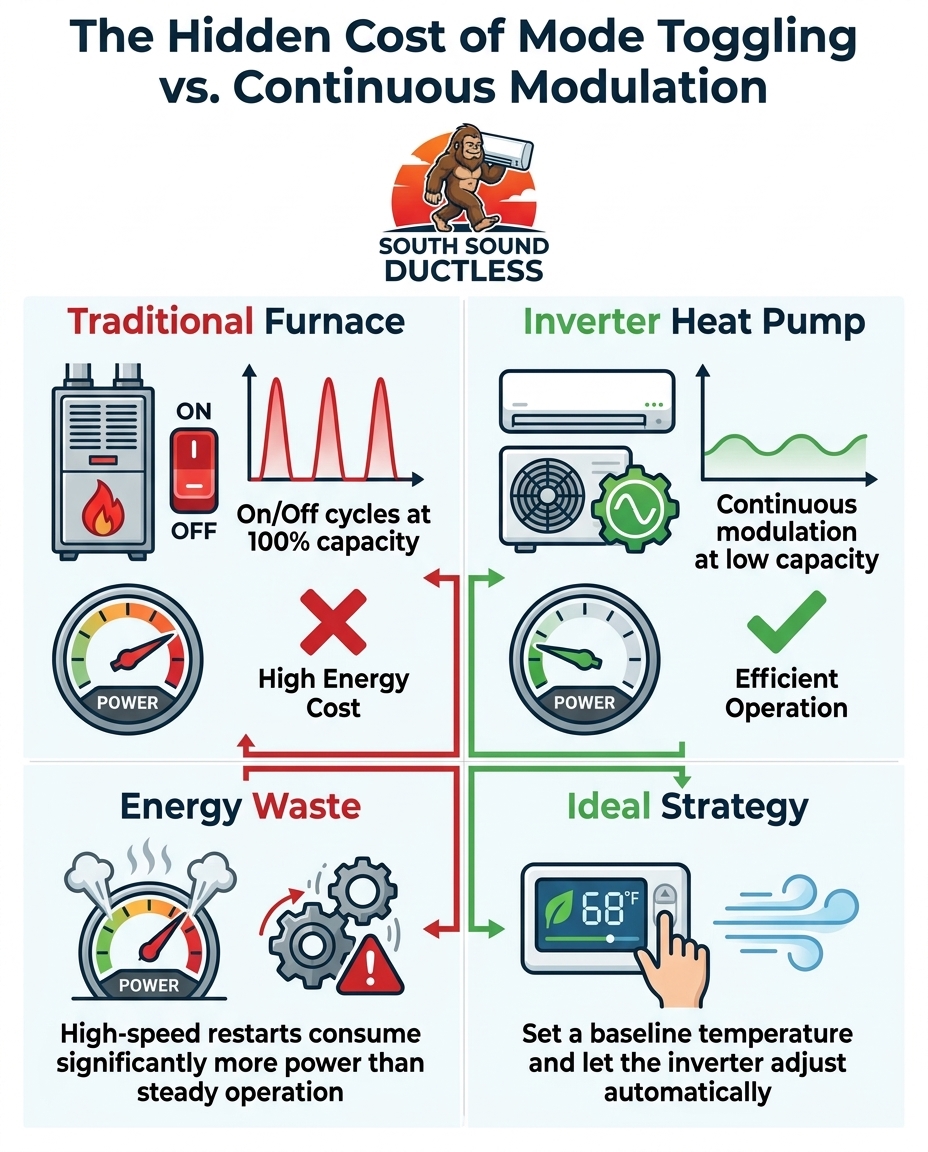
Traditional furnaces and central air conditioning units operate on a binary cycle. They are either 100% on or 100% off. When the house gets cold, a standard furnace blasts heated air at maximum capacity until the target temperature is reached, and then it shuts down completely. This creates a constant cycle of temperature spikes and drops.
Modern ductless systems use inverter-driven compressor technology. Instead of turning on and off, an inverter modulates its capacity continuously. Think of it like the accelerator pedal in a car. Rather than slamming on the gas and then slamming on the brakes, the inverter gently adjusts its speed to maintain a steady cruising temperature.
• Traditional Furnace — Operational Style: Binary (On/Off) — Energy Usage Pattern: High power spikes during startups — Comfort Level: Noticeable temperature swings
• Inverter Heat Pump — Operational Style: Continuous Modulation — Energy Usage Pattern: Steady, low-power operation — Comfort Level: Consistent, even room temperature
Because inverter systems are designed to run constantly at low speeds, applying the "furnace mindset" defeats their primary advantage. Turning the unit completely off when you leave the house, or aggressively changing modes as the sun comes up, forces the system to abandon its efficient low-speed operation. If you want to maximize your system's lifespan and efficiency, routine ductless maintenance in Tacoma is essential, but changing your daily operational habits is just as critical.
The Hidden Costs of Manually Toggling Modes
The problem: Constantly switching your system between heating and cooling during the transition months feels like the logical way to stay comfortable, but it actually creates a cascade of mechanical and financial issues.
The cause: Every time you switch from heat to cool, you force the outdoor unit's reversing valve to physically shift the flow of refrigerant. This is a heavy mechanical process. Furthermore, when you change modes or turn the system off and back on, the compressor has to restart at high speeds to satisfy the sudden new demand.
The solution: Stop toggling the remote. High-speed restarts consume significantly more electricity than steady, low-speed modulation. By forcing the system to constantly stop, reverse, and restart, you are burning excess power and increasing the likelihood of premature wear on the compressor. If you have been heavily toggling your system and notice strange noises or a drop in performance, you may need to look into ductless repair to address the strain placed on the reversing valve.
Beyond the mechanical strain, constant toggling disrupts the system's internal sensors. Your indoor unit relies on ambient temperature readings to tell the outdoor compressor how fast to run. When you frequently turn the unit off or flip the mode, the sensors lose their baseline reading of the room. The system has to start from scratch, guessing how much capacity is needed to condition the space, which leads to inefficient operation across the entire Tacoma area.
Why 'Auto' Mode Isn't Always the Magic Solution
Many homeowners discover the "Auto" button on their remote and assume it is the perfect solution for the September shoulder season. In theory, Auto mode automatically switches the system between heating and cooling based on your chosen setpoint. If you set it to 70 degrees, the system heats when the room drops to 68 and cools when the room hits 72.
However, this setting has a critical flaw when applied to multi-zone systems. If you have several indoor heads connected to a single outdoor compressor, they must all operate in the same mode. The outdoor unit cannot send hot refrigerant to your living room while simultaneously sending cold refrigerant to your bedroom.
During the rapid afternoon warm-ups typical of our region, a sunny living room might demand cooling while a shaded basement bedroom still demands heat. If your system is in Auto mode, this creates conflicting calls to the outdoor compressor. When this happens, the system enters a "standby" mode. The outdoor unit essentially freezes up, unable to decide which room to prioritize, leaving certain areas of your home completely unconditioned.
Because of this mechanical limitation, our technicians at South Sound Ductless strongly recommend avoiding Auto mode in multi-zone homes during highly variable weather. Instead of relying on the machine to guess which mode is appropriate, you need a strategy that keeps the compressor running smoothly in one direction.
The 'Set It and Forget It' Configuration Strategy
To handle temperature swings efficiently without straining your equipment, you need to adopt a "set and forget" mentality. This strategy allows the inverter to do what it does best: modulate slowly and efficiently. If you are struggling to get your system dialed in, our heating services team can help you calibrate your equipment for maximum performance.
1. Select a single mode for the season: During the transition to fall, select the "Heat" mode and leave it there. Resist the urge to switch to cooling just because the afternoon sun warms up the living room.
2. Find a comfortable baseline temperature: Set your remote to a moderate baseline, typically between 68 and 70 degrees. Put the remote in a drawer and leave it alone. The system will modulate down to a near-stop during the warm afternoons and gently ramp up as the evening chill sets in.
3. Utilize the 'Dry' mode strategically: Sometimes, a warm afternoon feels uncomfortable not because of the pure heat, but because of trapped indoor humidity. If you have a single-zone system, switching to "Dry" mode for a few hours removes moisture from the air without aggressively cooling the room, making the space feel much more comfortable.
4. Trust the sensors: Allow the indoor unit to read the room. If you constantly adjust the temperature up and down by five degrees, the system will constantly overcorrect, wasting energy in the process.
Optimizing Fan Speeds for Better Airflow
Your temperature setting is only half the equation; airflow management is equally important. To get the most out of your system across the Tacoma area, you must optimize how the air is distributed.
• Keep louvers directed properly: Warm air naturally rises, and cold air sinks. When in heating mode, direct the louvers downward toward the floor. This prevents the warm air from getting trapped at the ceiling. If you use cooling or dry mode, direct the louvers upward.
• Use the auto-fan setting: Set your fan speed to "Auto" rather than a fixed high or low speed. This allows the system to manage air distribution based on the inverter's current output. When the compressor ramps up, the fan blows harder; when the compressor modulates down, the fan slows to a whisper.
Transitioning Your System for the Approaching Winter
The erratic operation of early fall provides the perfect opportunity to evaluate your system's overall health before the heavy winter usage begins. The habits you build during the September shoulder season will carry you through the coldest months of the year.
• Clean your indoor reusable filters: This is the most critical maintenance task you can perform. The inverter relies on precise ambient temperature readings. If your filters are clogged with dust, the air cannot flow over the sensors properly. The system will misread the room, forcing it to run longer and harder than necessary. Clean your filters every four to six weeks.
• Clear outdoor unit debris: Fall means falling leaves. Check your outdoor compressor regularly to ensure leaves, twigs, and debris are not blocking the coils. The system needs unobstructed airflow to pull heat from the outside air. A suffocated outdoor unit will struggle to heat your home.
• Schedule a professional tune-up: Before the deep freezes arrive, have a professional inspect the reversing valve, check the refrigerant charge, and clean the blower wheel. Preventive maintenance is always preferable to a mid-winter breakdown. If you are unsure about the value of maintenance, consider the cost of emergency AC repair versus replacing a failing unit.
• Check your remote batteries: It sounds simple, but weak batteries can cause the remote to send partial signals to the indoor unit, resulting in erratic behavior. Start the heating season with fresh batteries.
Mastering Your Mini-Split for Year-Round Comfort
Resisting the urge to constantly adjust the remote is the absolute key to efficiency. Your ductless heat pump is an advanced piece of technology designed to do the heavy lifting automatically, provided you allow it to modulate as intended. By stepping away from the traditional furnace mindset, you save energy, protect your equipment, and enjoy a much more consistent indoor climate.
Modern heat pumps thrive on stability. Set your baseline temperature, point the louvers in the right direction, and let the inverter handle the Tacoma weather swings. If your system struggles to maintain a baseline temperature, or if you notice strange noises when the unit shifts modes, do not hesitate to reach out to local ductless specialists for seasonal maintenance and expert guidance.
Frequently Asked Questions
Should I leave my ductless heat pump on all the time?
Yes, you should leave your ductless heat pump running continuously. Inverter technology is designed to modulate its speed to maintain a steady temperature, which uses far less energy than turning the system off and forcing it to restart at maximum capacity when you return home.
Is it bad to switch a heat pump from heat to cool often?
Frequent switching causes unnecessary wear and tear on the system's reversing valve. Every time you change modes, the system must stop, reverse the flow of refrigerant, and restart at high speeds. This mechanical strain wastes electricity and can shorten the lifespan of the compressor.
What is the best setting for a mini split in the fall?
The most efficient strategy is to select the "Heat" mode and set a comfortable baseline temperature between 68 and 70 degrees. Leave the fan on "Auto" and allow the system to modulate its output automatically as the outdoor temperature fluctuates throughout the day.
How do you use auto mode on a ductless heat pump?
Auto mode allows the system to switch between heating and cooling based on a specific temperature setpoint. However, it should generally be avoided in multi-zone homes, as conflicting demands from different rooms can cause the outdoor compressor to lock into a standby mode, leaving spaces unconditioned.
Why does my mini-split blow cold air when it's set to heat?
This usually happens when the system enters its periodic defrost cycle to melt ice off the outdoor coils, temporarily blowing unheated air indoors. It can also occur if the indoor filters are severely clogged, preventing the system from properly reading the room temperature and distributing heat.
Can frequent mode changes damage my ductless compressor?
Yes, constantly forcing the compressor to stop and restart at high speeds places significant mechanical stress on the unit. Over time, this rapid cycling increases the risk of component failure and significantly degrades the overall efficiency of the heat pump.
"The DIY ductless installation was straightforward and saved us a lot of money! I highly recommend South Sound Ductless for their excellent support and quality products."


"Our new ductless system has transformed our home’s comfort level. The team at South Sound Ductless was professional and knowledgeable throughout the process!"
Get Your Comfort Today!
Contact us for expert HVAC solutions and consultations.
Stay Updated with Our Newsletter
Subscribe for expert HVAC tips, the latest updates, and exclusive promotions delivered right to your inbox.

FAQs
Here are some common questions about our HVAC services and ductless systems.
Ductless heating uses a system of indoor and outdoor units to provide efficient heating. These systems are ideal for homes without existing ductwork. They offer flexibility and can be controlled room by room.
Our DIY ductless program simplifies installation with pre-charged kits. You can easily mount the indoor unit, connect refrigerant lines, and set up the outdoor condenser. It's designed for quick and efficient setup.
Ductless systems provide energy efficiency, reducing utility bills while maintaining comfort. They improve indoor air quality and allow for customizable temperature control. Additionally, they take up less space than traditional systems.
Yes, we offer financing through Enhancify to make your HVAC investments more manageable. This allows you to enjoy comfort without the immediate financial burden. Explore our options to find a plan that suits you.
Regular maintenance is key to keeping your ductless system running efficiently. Schedule annual tune-ups and clean the filters regularly. This ensures optimal performance and prolongs the life of your system.
Still have questions?
We're here to help!