

Decoding the True Timeline of a Full AC Installation in Bonney Lake
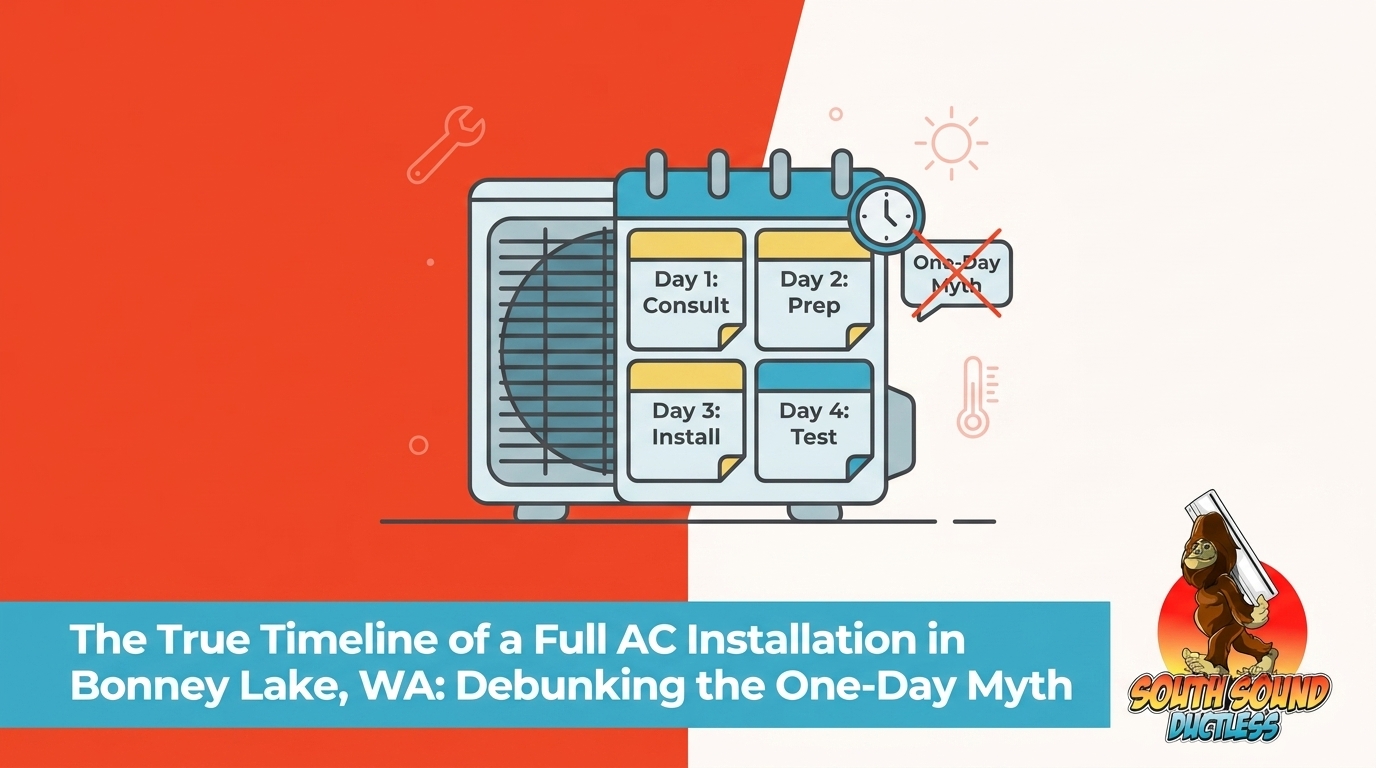
Why Rushing an AC Upgrade During a Heatwave Costs You Later
At South Sound Ductless, we know firsthand that when your cooling system just failed, decoding the true timeline of a full AC installation in Bonney Lake becomes your top priority while the house is sweltering. Enduring a July peak summer heatwave without a functioning air conditioner is miserable, and the natural reaction is to seek immediate relief. You want a new system installed today, or at the very latest, tomorrow morning. However, expecting immediate, same-day installation during peak summer demand often leads to rushed decisions, skipped technical steps, and long-term mechanical headaches.
Before you sign off on a contractor who promises overnight miracles, understanding the necessary timeline milestones is essential to protecting your home. For comprehensive air conditioning services, including professional AC installation in Bonney Lake, you need a team that prioritizes precision over speed.
The Psychology of Panic Buying HVAC Equipment
Hotter summer spikes in the Tacoma area consistently drive panic-buying among homeowners. In our years of restoring comfort to local homes, we've noticed a clear pattern: when indoor temperatures climb past 85 degrees, the urgency to fix the problem often overrides the patience required to plan a proper home upgrade. Unfortunately, some contractors prey on this desperation by offering "next-day" installations that completely bypass mandatory industry standards.
The true cost of speed: When you rush a major mechanical installation, you are almost certainly sacrificing proper sizing, legal permitting, and rigorous testing. These skipped steps might get cold air blowing 24 hours sooner, but they set the stage for years of high energy bills, frequent breakdowns, and premature equipment failure.
• Guesses equipment size based on old unit — Methodical, Professional Installations: Performs precise mathematical load calculations
• Skips local municipal permitting — Methodical, Professional Installations: Secures legal permits and schedules inspections
• Rushes refrigerant line preparation — Methodical, Professional Installations: Thoroughly tests and vacuums refrigerant lines
• Leaves immediately after turning unit on — Methodical, Professional Installations: Stays to commission and verify system performance
The Danger of the 'One-Day Magic' Installation Myth
The idea that a high-quality, fully permitted air conditioning system can be sized, sourced, approved, and installed instantly without cutting corners is a widespread myth. In reality, our team approaches proper installation as a complex construction project tailored specifically to your home's unique thermal dynamics.
When a company guarantees they can install a brand-new system in Bonney Lake within 24 hours of your first phone call during peak season, they are usually skipping the vital administrative and technical groundwork required for a safe, efficient system.
What Gets Skipped for Speed?
To achieve a same-day turnaround, certain corners must be cut. Here is exactly what is typically sacrificed when speed is prioritized over quality:
• Proper load calculations: The contractor simply swaps your old unit for a new one of the same size, ignoring any changes to your home's insulation, windows, or layout.
• Legal permitting: Pulling permits takes time. Rushed jobs often bypass the local building department entirely, leaving you with an illegal installation.
• Ductwork assessment: Fast installs rarely check if your existing ductwork can actually handle the airflow requirements of modern, high-efficiency blowers.
• Proper vacuuming: Rushing the removal of moisture and non-condensables from the refrigerant lines can destroy a new compressor within a few years.
The value of honest communication: At South Sound Ductless, our team operates with a commitment to transparent communication and realistic scheduling over false, rushed promises. Setting realistic expectations for a complex home upgrade protects your investment. You deserve to know exactly how long the process will take, why each step matters, and what to expect along the way.
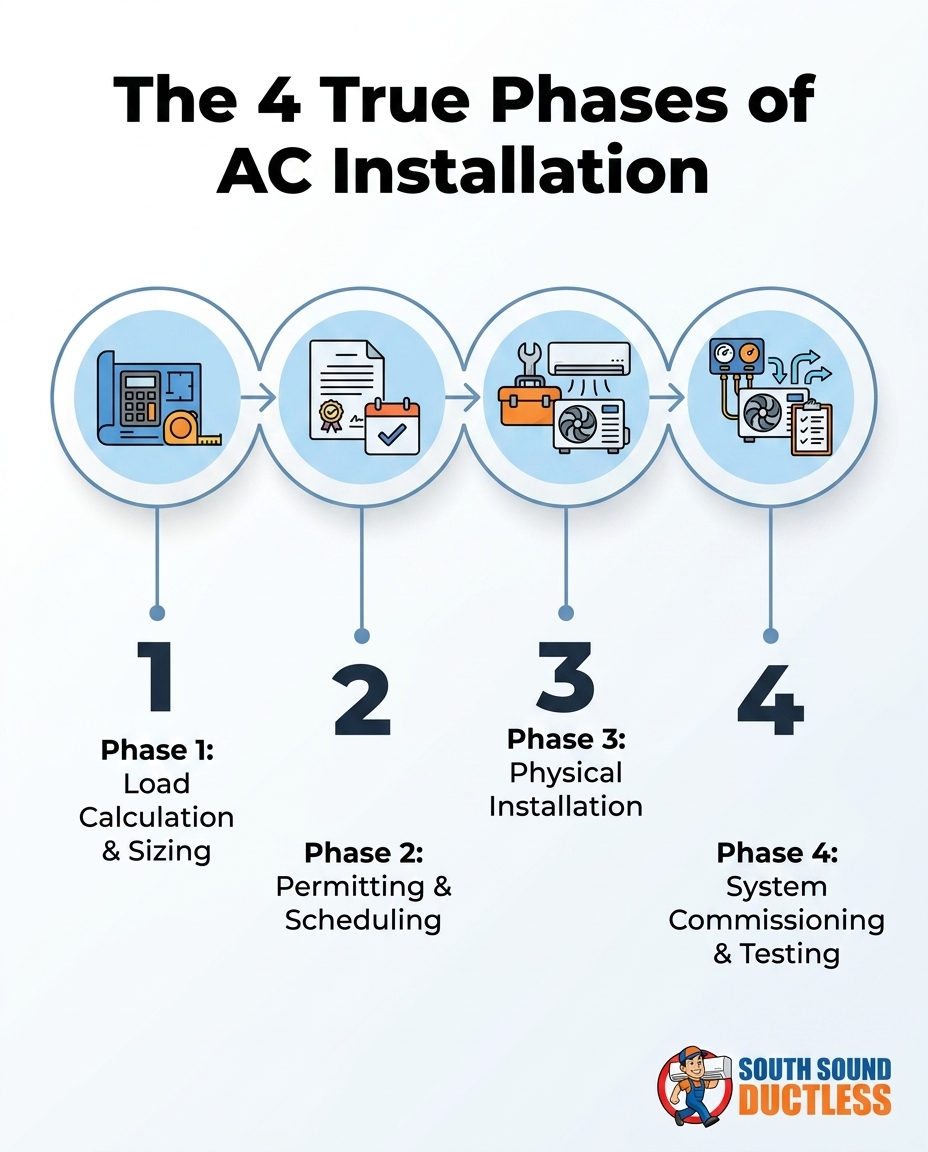
Phase 1: Accurate Load Calculation and System Sizing
The foundation of any successful air conditioning installation begins long before a wrench is turned. The mandatory first step is an accurate assessment of your home's specific cooling needs. This cannot be guessed, and it cannot be based solely on the square footage of your property.
The ACCA Manual J Standard
Professional HVAC technicians use an industry-standard protocol known as the ACCA Manual J load calculation. This process takes time, which is why we always make it the very first phase of your timeline.
1. Evaluating the thermal envelope: Technicians measure the square footage, ceiling heights, and layout of your home.
2. Assessing insulation and windows: The quality of your attic insulation, the orientation of your windows, and the presence of shade trees all impact how much heat your home absorbs during a July peak summer heatwave.
3. Calculating occupancy and heat generation: The number of people living in the home and the heat generated by large appliances are factored into the equation.
4. Determining exact equipment size: The final calculation dictates the precise tonnage required to cool your home efficiently.
The Consequences of Guessing Equipment Size
Bigger is not better: If a contractor skips the Manual J calculation and installs an oversized unit, the system will short-cycle. This means it turns on, blasts cold air, and shuts off rapidly before it has a chance to dehumidify the air. You end up with a cold, clammy house and worn-out contactors.
Undersized struggles: Conversely, an undersized unit will run continuously, struggling to reach the set temperature and driving your energy bills through the roof while failing to keep you comfortable.
Phase 2: Navigating Local Permitting and Scheduling
Once the equipment is properly sized and selected, the next phase involves administrative compliance. Navigating local permitting and scheduling is a critical step that cannot be bypassed for convenience.
Understanding Mechanical Permits
In our experience working throughout Pierce County and surrounding municipalities, mechanical permits are legally required for new HVAC installations. This process involves submitting the proposed equipment specifications and installation plans to the local building department.
Why permits matter: While waiting for permit approval adds time to the schedule, it protects your safety and your property value. A permitted job guarantees that an independent city inspector will eventually review the work to ensure it meets strict electrical, structural, and mechanical safety codes. When you eventually sell your home in Bonney Lake, unpermitted mechanical work can derail the sale or force you into costly retroactive inspections.
Coordinating the Installation Date
Scheduling the physical installation must align with three distinct variables: permit approval timelines, equipment availability from regional distributors, and technician availability.
When you partner with a professional heating and air conditioning service in Bonney Lake, the administrative team handles this coordination behind the scenes. They ensure that by the time the technicians arrive at your home, all legal paperwork is filed, and the exact required equipment is loaded on the truck.
Phase 3: The Physical Installation Day Explained
When installation day finally arrives, the process is methodical and precise. A full system replacement is a major construction event that requires specialized tools, handling of high-voltage electricity, and the management of pressurized refrigerants.
The Step-by-Step Daily Timeline
Here is what happens during the physical labor phase of the project:
1. Safe decommissioning and removal: The day begins with the safe recovery of old refrigerant using specialized EPA-approved equipment. The technicians then disconnect the high-voltage wiring, remove the old condenser, and extract the indoor evaporator coil.
2. Site preparation: The team prepares the outdoor pad, ensuring it is level and stable. Inside, they inspect the plenum and prepare the ductwork connections to receive the new coil.
3. Setting the new equipment: The new outdoor condenser and indoor coil are carefully positioned. If you are opting for a ductless installation, this phase involves mounting the indoor air handlers and routing the conduit through the exterior walls.
4. Brazing and connecting refrigerant lines: Technicians weld the copper refrigerant lines, flowing nitrogen through the pipes to prevent oxidation and soot buildup inside the system.
5. Electrical integration: High-voltage whips, disconnect boxes, and low-voltage communication wires are connected and secured according to local electrical codes.
The time commitment: A standard central air replacement typically takes a full working day (8 to 10 hours) for our seasoned South Sound Ductless crews. Complex installations, custom ductwork modifications, or multi-zone systems in Bonney Lake can extend this phase into a second day.
Phase 4: System Commissioning and Performance Testing
The physical installation is only part of the job. The final, and arguably most important, phase is system commissioning. This is where we prove that the system operates exactly as the manufacturer intended.
The Critical Testing Checklist
Turning the thermostat to "cool" and feeling cold air is not enough. Proper commissioning involves rigorous testing to verify high-efficiency operation, especially when preparing the system to handle a July peak summer heatwave.
• Pulling a deep vacuum: Before releasing refrigerant, technicians use a vacuum pump and a micron gauge to remove all air and moisture from the copper lines. Even a drop of moisture left inside can mix with refrigerant oil to create damaging acids.
• Charging the system: The technicians measure the exact subcooling and superheat temperatures to ensure the refrigerant charge is perfectly balanced for your specific line set length.
• Verifying airflow: Static pressure is measured to ensure the blower motor is pushing the correct volume of air across the coil without straining against restrictive ductwork.
• Thermostat communication: The team verifies that the thermostat is properly communicating all stages of cooling, which is particularly vital for maximizing the technical advantage of inverter-driven systems.
Protecting your warranty: Skipping the commissioning phase is the fastest way to void a manufacturer warranty. Manufacturers require proof that the system was installed and tested to their exact specifications. A detailed commissioning report serves as your proof of a flawless installation.
How Peak Season Demand Shifts Your Wait Times
Understanding the standard four-phase timeline is helpful, but external factors heavily influence exactly how many days or weeks this process will take. The time of year you choose to upgrade plays a massive role in your wait time.
The Reality of Summer Bottlenecks
During a severe July peak summer heatwave, we consistently see the entire regional HVAC supply chain experience intense strain. When thousands of local homeowners experience simultaneous breakdowns, the demand for equipment and labor skyrockets.
• Initial Consultation — Shoulder Season (Spring/Fall): Within 1-3 days — Peak Season (Summer Heatwaves): Often 1-2 weeks out
• Equipment Sourcing — Shoulder Season (Spring/Fall): Readily available locally — Peak Season (Summer Heatwaves): Subject to regional backorders
• Permit Processing — Shoulder Season (Spring/Fall): Standard municipal turnaround — Peak Season (Summer Heatwaves): Delayed due to high application volume
• Installation Day — Shoulder Season (Spring/Fall): Flexible scheduling — Peak Season (Summer Heatwaves): Booked solid weeks in advance
Supply chain realities: Sourcing specific equipment—especially high-efficiency inverter heat pumps or specific condenser tonnages—can take longer during peak season. Regional distributors often sell out of popular models, requiring contractors to wait for factory shipments. Booking your consultation early, before your current system completely fails, is the best way to prevent extended misery during the hottest months.
Setting Realistic Expectations for Your Cooling Upgrade
A successful air conditioning upgrade is a marathon, not a sprint. By prioritizing proper sizing, legal permitting, and rigorous testing over the illusion of speed, you ensure that your investment will provide reliable comfort for the next 15 to 20 years.
The bottom line: A methodical installation process guarantees reliable, long-term performance. Whether you are building a new home or replacing a failing unit in Bonney Lake, starting the consultation process early gives you the time needed to make educated decisions without the pressure of a sweltering living room.
Expect the process to take time. Expect your contractor to measure your home, pull permits, and spend hours testing the system after it is turned on. A clear, realistic timeline outlining each phase of the installation process is the hallmark of a contractor who respects your home and your investment.
Frequently Asked Questions
How long does it take to install a central air conditioner?
The physical installation of a central air conditioner typically takes one full working day (8 to 10 hours) for a standard replacement. However, the entire process from the initial consultation to the final commissioning can take anywhere from a few days to several weeks. This extended timeline accounts for mandatory load calculations, equipment sourcing, and municipal permit approvals. Complex installations involving custom ductwork or multi-zone configurations may require two or more days of physical labor.
Can an AC be installed in one day?
While the physical labor of swapping out equipment can often be completed in a single day, a fully compliant and properly sized installation cannot happen overnight from your first phone call. Contractors promising immediate, same-day service are usually skipping critical steps like ACCA Manual J load calculations and pulling local permits. True professional installations require administrative preparation before the technicians ever arrive at your property.
Do I need a permit to install an AC in Washington state?
Yes, mechanical permits are required for new HVAC installations across Washington state, including Pierce County and local municipalities. Pulling a permit ensures that the installation complies with current safety, electrical, and building codes. An independent city inspector will eventually review the work, protecting your property value and ensuring the system operates safely.
What happens during an AC installation?
An AC installation begins with the safe recovery of old refrigerant and the removal of your existing equipment. Technicians then prepare the site, set the new outdoor condenser and indoor evaporator coil, and braze the copper refrigerant lines. Once the physical components are integrated with your ductwork and electrical system, the technicians pull a deep vacuum on the lines and perform rigorous commissioning tests to verify proper airflow and refrigerant charge.
Why does proper AC sizing add time to the installation process?
Proper AC sizing requires a technician to perform a detailed Manual J load calculation, which involves measuring your home's square footage, ceiling heights, window orientations, and insulation quality. This mathematical assessment takes time to complete accurately. Skipping this step and guessing the size often leads to short-cycling, poor humidity control, and premature system failure, making the initial time investment highly worthwhile.
How do summer heatwaves affect AC equipment availability in Pierce County?
Severe summer heatwaves cause a massive spike in emergency replacement requests, which puts intense strain on regional HVAC supply chains and contractor schedules. During these peak periods, local distributors may run out of popular equipment sizes, leading to backorders and extended wait times for parts. Additionally, contractor availability becomes limited, meaning you may wait longer for an initial consultation and available installation dates.
"The DIY ductless installation was straightforward and saved us a lot of money! I highly recommend South Sound Ductless for their excellent support and quality products."


"Our new ductless system has transformed our home’s comfort level. The team at South Sound Ductless was professional and knowledgeable throughout the process!"
Get Your Comfort Today!
Contact us for expert HVAC solutions and consultations.
Stay Updated with Our Newsletter
Subscribe for expert HVAC tips, the latest updates, and exclusive promotions delivered right to your inbox.

FAQs
Here are some common questions about our HVAC services and ductless systems.
Ductless heating uses a system of indoor and outdoor units to provide efficient heating. These systems are ideal for homes without existing ductwork. They offer flexibility and can be controlled room by room.
Our DIY ductless program simplifies installation with pre-charged kits. You can easily mount the indoor unit, connect refrigerant lines, and set up the outdoor condenser. It's designed for quick and efficient setup.
Ductless systems provide energy efficiency, reducing utility bills while maintaining comfort. They improve indoor air quality and allow for customizable temperature control. Additionally, they take up less space than traditional systems.
Yes, we offer financing through Enhancify to make your HVAC investments more manageable. This allows you to enjoy comfort without the immediate financial burden. Explore our options to find a plan that suits you.
Regular maintenance is key to keeping your ductless system running efficiently. Schedule annual tune-ups and clean the filters regularly. This ensures optimal performance and prolongs the life of your system.
Still have questions?
We're here to help!