

Why Your Tacoma AC Runs Fine in July but Struggles in Late August
The Late-Summer Shift: When Your Cooling System Hits a Wall
Summer in the Pacific Northwest is winding down, which makes it incredibly frustrating when you are trying to figure out why your Tacoma AC runs fine in July but struggles in late August. Just a few weeks ago, your cooling system was easily managing the early summer heatwaves. The house felt crisp, the vents blew ice-cold air, and the thermostat satisfied your set temperature without a hitch. Now, as the season drags on, you might notice the air feels noticeably less cold, the outdoor unit sounds louder than usual, or the system simply refuses to turn off.
This late-summer sluggishness is a classic pattern we see frequently by late August in the Pacific Northwest. The root cause is rarely the temperature outside on any given afternoon. Instead, the culprit is cumulative fatigue. Your air conditioner has been working tirelessly for months, and that continuous operation takes a hidden physical toll on the internal electrical and mechanical components. Every hour your system runs without a sufficient cooling interval, the internal heat builds up, slowly degrading the parts that keep the cold air flowing.
You are now facing a critical decision point as a homeowner. It is tempting to ignore a sluggish air conditioner, hoping it will just limp across the finish line until the autumn weather arrives. However, pushing an exhausted, struggling system through the final hot weeks of the year is exactly how minor wear and tear escalates into a catastrophic mechanical failure. If your system needs comprehensive air conditioning services or urgent AC repair in Tacoma before the season ends, taking action now prevents a much larger headache. Catching component fatigue early is always more practical than replacing a completely burned-out compressor.
The Myth of the Daily High vs. Cumulative Runtime Fatigue
Most homeowners assume that an air conditioning breakdown is triggered by a record-breaking daily high temperature. If the thermometer hits 95 degrees in Tacoma WA, you expect your system to work hard. But surprisingly, the majority of late-summer cooling failures happen on relatively normal, warm afternoons. The reason behind this comes down to the difference between acute heat stress and chronic, compounding electrical fatigue.
Think of your cooling system like a marathon runner. In early July, the system is fresh. It can sprint through a three-day heatwave, cycle off, and recover perfectly. But by the time August rolls around, that same system has accumulated hundreds of hours of continuous cycling. Continuous cycling refers to how long the unit runs without stopping. During prolonged dry spells, the system never gets a chance to fully power down and cool its internal motors. This eliminates the vital recovery periods that HVAC systems require to shed excess heat from their electrical housings.
Unlike the acute issues we see when diagnosing AC units freezing up during July heat spikes—which are often tied to sudden airflow blockages or immediate refrigerant pressure drops—late-season failures are chronic. The damage compounds slowly over weeks of non-stop operation.
Understanding the Wear and Tear Timeline
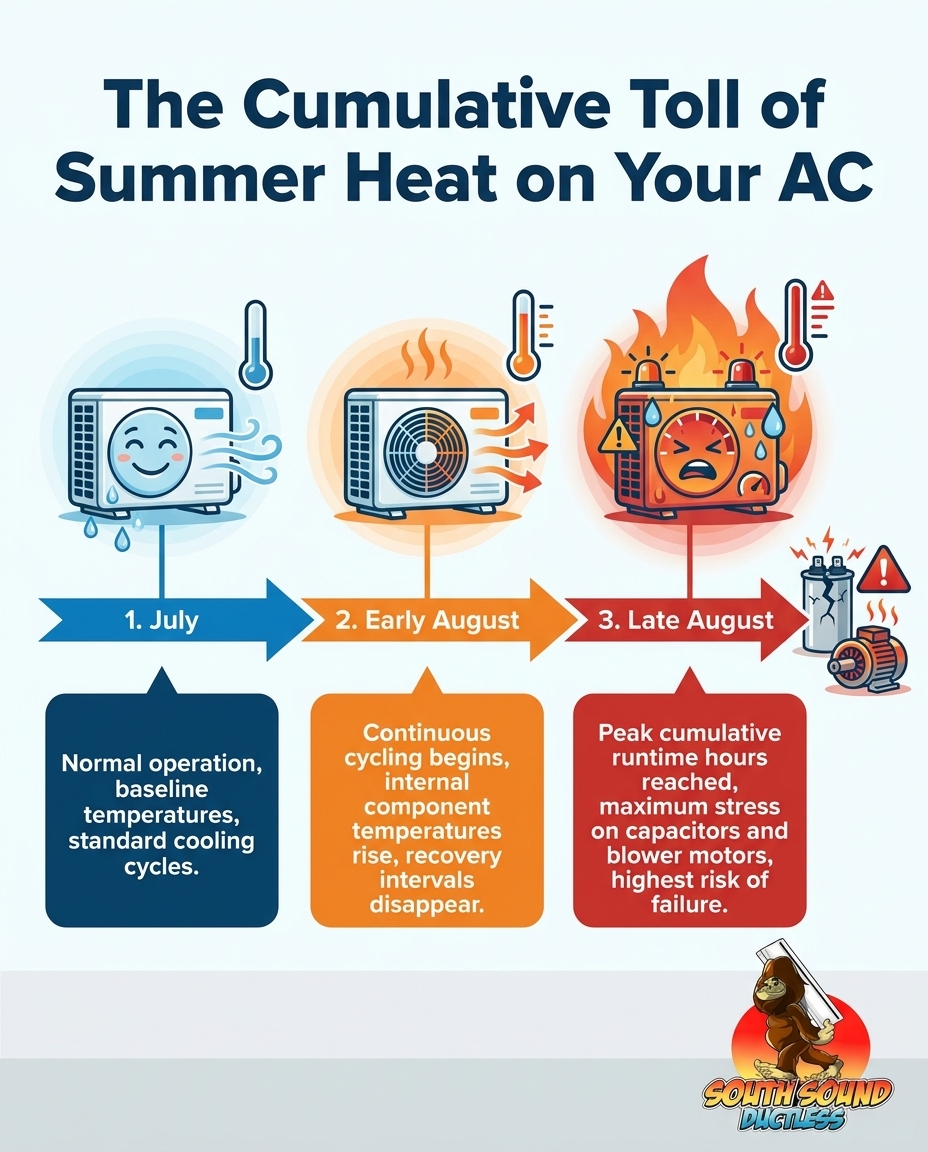
To understand why late August is so brutal on your equipment, you have to look at the math of runtime hours. An air conditioner is designed to run in cycles, typically 15 to 20 minutes at a time, followed by a resting period. When the weather stays consistently hot for weeks, those cycles stretch to 40 minutes, 60 minutes, or even continuous operation.
• Early Summer (June/July) — Typical Cycling Pattern: 15-20 minute cycles with long recovery intervals. — Component Impact: Normal wear. Internal temperatures remain within safe design limits.
• Mid-Summer Heatwaves — Typical Cycling Pattern: 30-45 minute cycles with short recovery intervals. — Component Impact: Elevated stress. Components begin retaining heat between cycles.
• Late Summer (August) — Typical Cycling Pattern: Continuous or near-continuous operation. — Component Impact: Maximum fatigue. Heat saturation degrades electrical storage and motor lubricants.
By the time late August arrives, the internal temperature of the outdoor unit's electrical panel has been elevated for weeks. This chronic heat exposure physically alters the materials inside the unit, leading directly to the most common late-summer failures we see in the field.
The Silent Victim of Continuous Cycling: Your AC Capacitor
If there is one specific part that bears the brunt of late-summer continuous cycling, it is the AC capacitor. To understand why your system is struggling, you need to understand what this small but mighty component does. In plain English, a capacitor acts like a powerful, rechargeable battery for your air conditioner. The motors inside your AC—specifically the compressor and the fan motor—require a massive jolt of electricity to start up. Your home's standard electrical wiring cannot provide this surge all at once. The capacitor stores up energy and delivers that high-voltage jump-start every time the thermostat calls for cooling.
Because the capacitor is constantly storing and releasing electrical energy, it naturally generates its own internal heat. Under normal conditions, the resting period between cooling cycles allows the capacitor to cool down. However, during weeks of non-stop running, that resting period disappears. The capacitor is forced to operate at an elevated temperature for hundreds of hours on end.
When a capacitor begins to fail from cumulative fatigue, your system will start showing distinct warning signs. Pay close attention to these symptoms:
1. Clicking noises at startup: You might hear a distinct clicking sound coming from the outdoor unit, but the fan or compressor fails to engage immediately.
2. Hard starts and stuttering: The system may sound like it is struggling to turn on, dimming the lights in your house momentarily before finally roaring to life.
3. Humming without the fan turning: The outdoor unit emits a low electrical hum, but the fan blades remain completely still.
4. Warm air from the vents: If the capacitor fails to start the compressor, the indoor fan will simply blow uncooled, room-temperature air through your ductwork.
How Heat Degrades Electrical Components Over Time
The science behind this failure is well-documented. General ASHRAE standards on residential electrical component operating temperatures dictate that parts like capacitors are rated for specific heat thresholds. Inside the metal casing of a capacitor, there is a specialized dielectric fluid that helps hold the electrical charge. When the internal operating temperature of the unit is breached repeatedly over several weeks, this fluid begins to break down and degrade.
Once that heat tolerance is exceeded for long enough, the capacitor's ability to hold a microfarad charge drops permanently. It cannot be repaired or "recharged"—it is physically spent. Because these components deal with high-voltage electricity, testing and replacing a degraded capacitor requires specialized diagnostic tools and safety training. It is never a DIY project, as the stored electrical charge remains dangerous even after the main power is shut off.
Blower Motor Burnout: When the Airflow Slows Down
While the capacitor is baking in the outdoor unit, your indoor blower motor is fighting its own battle against cumulative fatigue. The blower motor is responsible for pushing the conditioned air through your ductwork and out of the vents. During a prolonged heatwave, this motor is working overtime, spinning constantly to try and satisfy the thermostat's demands.
The strain on the blower motor is often compounded by restricted airflow. Think back to early July. If you haven't changed your air filter since the beginning of the summer, that filter has spent two months collecting dust, pet dander, and airborne particles. A clogged filter acts like a wall, forcing the blower motor to pull harder to draw air into the system. This lack of airflow removes the motor's primary cooling mechanism—the very air it is circulating. When the motor cannot cool itself, the internal windings overheat, and the protective lubricants dry out.
As blower motor degradation sets in, you will notice specific changes in your indoor comfort. Watch for these bold warning signs:
• Weak airflow at the vents: You can hear the system running, but you can barely feel the air coming out of the registers, even when standing right next to them.
• Unusual screeching or grinding noises: As the internal bearings lose their lubrication due to extreme heat, metal grinds against metal, creating a high-pitched squeal.
• A distinct burning smell: If the motor's electrical windings begin to melt from overheating, a faint, metallic burning odor will circulate through your home's air vents.
Addressing these symptoms early is the best way to protect your investment. Scheduling routine AC maintenance allows a technician to measure the electrical draw of the motor, clear away airflow restrictions, and ensure the bearings are operating smoothly, which prevents total motor burnout.
How Pacific Northwest Weather Patterns Stress Residential HVAC Systems
To fully grasp why late-August breakdowns are so common here, you have to look at the unique climate context of Tacoma WA. Historically, the Pacific Northwest was known for highly moderate summers. Because extreme heat was rare, many older residential cooling systems, ductwork designs, and insulation profiles were not originally sized for prolonged, multi-week heatwaves.
Over recent years, that climate pattern has shifted. Tacoma's late summer weather patterns often feature prolonged dry heat in August following July's initial heat spikes. This specific weather sequence maximizes continuous system runtime. A system that was perfectly designed to handle a few 85-degree days in July is suddenly forced to operate outside its historical design parameters, running continuously against 90-plus degree heat for weeks on end.
This prolonged dry heat forces the compressor to run at maximum capacity while battling elevated outdoor ambient temperatures. The condenser coils struggle to reject the heat pulled from inside your home because the outside air is already baking. This double-sided thermal stress accelerates the wear and tear on every moving part.
The Value of Local Climate Expertise
Generic, national HVAC advice often misses this nuance. A technician from the Southwest might expect a system to run continuously for six months without issue because those systems are sized and built for extreme desert environments. However, understanding how residential systems in our specific region react to compounding late-summer heat requires deep local knowledge.
Working with a local expert means your technician understands the historical sizing practices of the area and the specific wear-and-tear patterns caused by our regional climate shifts. This is why relying on a local Tacoma heating and air conditioning service matters. We know exactly how the transition from July to August impacts the specific makes and models installed in our local neighborhoods, allowing for faster, more accurate diagnostics.
Sluggish Performance vs. Imminent Failure: When You Need an AC Fix
As we move deeper into late August in the Pacific Northwest, it can be difficult to tell the difference between a cooling system that is simply battling a hot afternoon and a system that is actively failing. You do not want to panic over a minor issue, but you also cannot afford to ignore the warning signs of an impending breakdown.
Evaluating your system's performance requires looking at a few key indicators. If your system is just struggling with the peak afternoon heat, it should eventually catch up and cool the house once the sun goes down. But if the performance remains sluggish well into the evening, you are likely looking at a mechanical issue that requires a professional ac fix.
Here is a clear checklist to help you distinguish between normal late-summer operation and a situation that requires an ac emergency repair:
• The system runs but never reaches the set temperature: If you set the thermostat to 72 degrees, and the system runs for six hours straight but the indoor temperature never drops below 78 degrees, the system is actively failing. This often points to a failing compressor or severe refrigerant flow issues.
• Short cycling: If the unit turns on, runs for three minutes, shuts off, and immediately turns back on, it is short cycling. This is a massive red flag. It destroys capacitors and motors rapidly and requires immediate intervention.
• Ice formation on the refrigerant lines: If you see a buildup of white ice on the copper pipes outside or on the indoor evaporator coil, the system is suffocating. This is a severe issue that will eventually destroy the compressor if left running.
• Unresponsive outdoor unit: If the indoor fan is blowing air, but the large metal box outside is completely silent and still, the communication or power delivery has failed.
Catching capacitor or motor fatigue early is vastly preferable to a total system breakdown. If you notice any of these severe symptoms, turning the system off at the thermostat and calling for professional diagnostics is the safest way to protect your equipment from permanent damage.
Frequently Asked Questions About Late-Summer AC Struggles
Why does my AC struggle at the end of summer?
Your AC struggles at the end of summer due to the cumulative fatigue of continuous cycling over the previous months. By August, the internal electrical components, like capacitors and motors, have endured hundreds of hours of elevated heat without sufficient cooling intervals. This prolonged thermal stress degrades their performance, causing the system to run longer cycles while producing less cold air.
What happens when an AC capacitor overheats?
When an AC capacitor overheats repeatedly, the internal dielectric fluid that holds the electrical charge begins to break down permanently. Once this happens, the capacitor can no longer deliver the massive jolt of electricity required to start the compressor and fan motors. This forces the motors to strain and overheat, eventually leading to a complete system startup failure.
How long should an AC run continuously on a hot day?
On a moderately hot day, a properly functioning AC should run in cycles of 15 to 20 minutes before shutting off to rest. During extreme, prolonged heatwaves, it is normal for the system to run for 40 to 60 minutes at a time to keep up with the heat load. However, if your system is running non-stop for hours on end without ever satisfying the thermostat, it indicates a mechanical struggle or severe airflow restriction.
Why is my AC running but not cooling in August?
If your AC is running but not cooling in August, it usually means the indoor blower is working, but the outdoor compressor has failed to engage. This is most frequently caused by a burned-out capacitor that can no longer start the outdoor unit. It can also be caused by a severely clogged air filter that has accumulated months of summer dust, completely blocking the chilled air from reaching your vents.
How do I know if I need an AC emergency repair in late summer?
You need an emergency repair if your system is short-cycling (turning on and off every few minutes), making loud grinding or screeching noises, or emitting a burning electrical smell. Additionally, if the system runs continuously for hours but the indoor temperature continues to rise, shutting the unit off and calling a professional is necessary to prevent a catastrophic compressor failure.
Don't Wait for a Total Breakdown This August
Understanding why your Tacoma AC runs fine in July but struggles in late August comes down to recognizing the hidden toll of continuous cycling. Late-summer AC struggles are a clear warning sign of cumulative part fatigue, not just a temporary symptom of hot weather. When capacitors bake in the prolonged heat and blower motors strain against restricted airflow, the system gives you warning signs before it completely fails.
If your cooling system is showing signs of stress, blowing weak air, or making unusual noises, do not wait for it to permanently shut down on the hottest day of the year. Getting a logical, plain-English diagnostic from a professional allows you to address degraded parts before they cause a domino effect of mechanical damage. If you are noticing these late-season symptoms, scheduling an AC repair in Tacoma now will ensure your home stays comfortable through the end of the season, giving you the reliable performance you expect.
"The DIY ductless installation was straightforward and saved us a lot of money! I highly recommend South Sound Ductless for their excellent support and quality products."


"Our new ductless system has transformed our home’s comfort level. The team at South Sound Ductless was professional and knowledgeable throughout the process!"
Get Your Comfort Today!
Contact us for expert HVAC solutions and consultations.
Stay Updated with Our Newsletter
Subscribe for expert HVAC tips, the latest updates, and exclusive promotions delivered right to your inbox.

FAQs
Here are some common questions about our HVAC services and ductless systems.
Ductless heating uses a system of indoor and outdoor units to provide efficient heating. These systems are ideal for homes without existing ductwork. They offer flexibility and can be controlled room by room.
Our DIY ductless program simplifies installation with pre-charged kits. You can easily mount the indoor unit, connect refrigerant lines, and set up the outdoor condenser. It's designed for quick and efficient setup.
Ductless systems provide energy efficiency, reducing utility bills while maintaining comfort. They improve indoor air quality and allow for customizable temperature control. Additionally, they take up less space than traditional systems.
Yes, we offer financing through Enhancify to make your HVAC investments more manageable. This allows you to enjoy comfort without the immediate financial burden. Explore our options to find a plan that suits you.
Regular maintenance is key to keeping your ductless system running efficiently. Schedule annual tune-ups and clean the filters regularly. This ensures optimal performance and prolongs the life of your system.
Still have questions?
We're here to help!